

IV Drip in Dubai: What's in the Bag, What It Does, and What It Costs
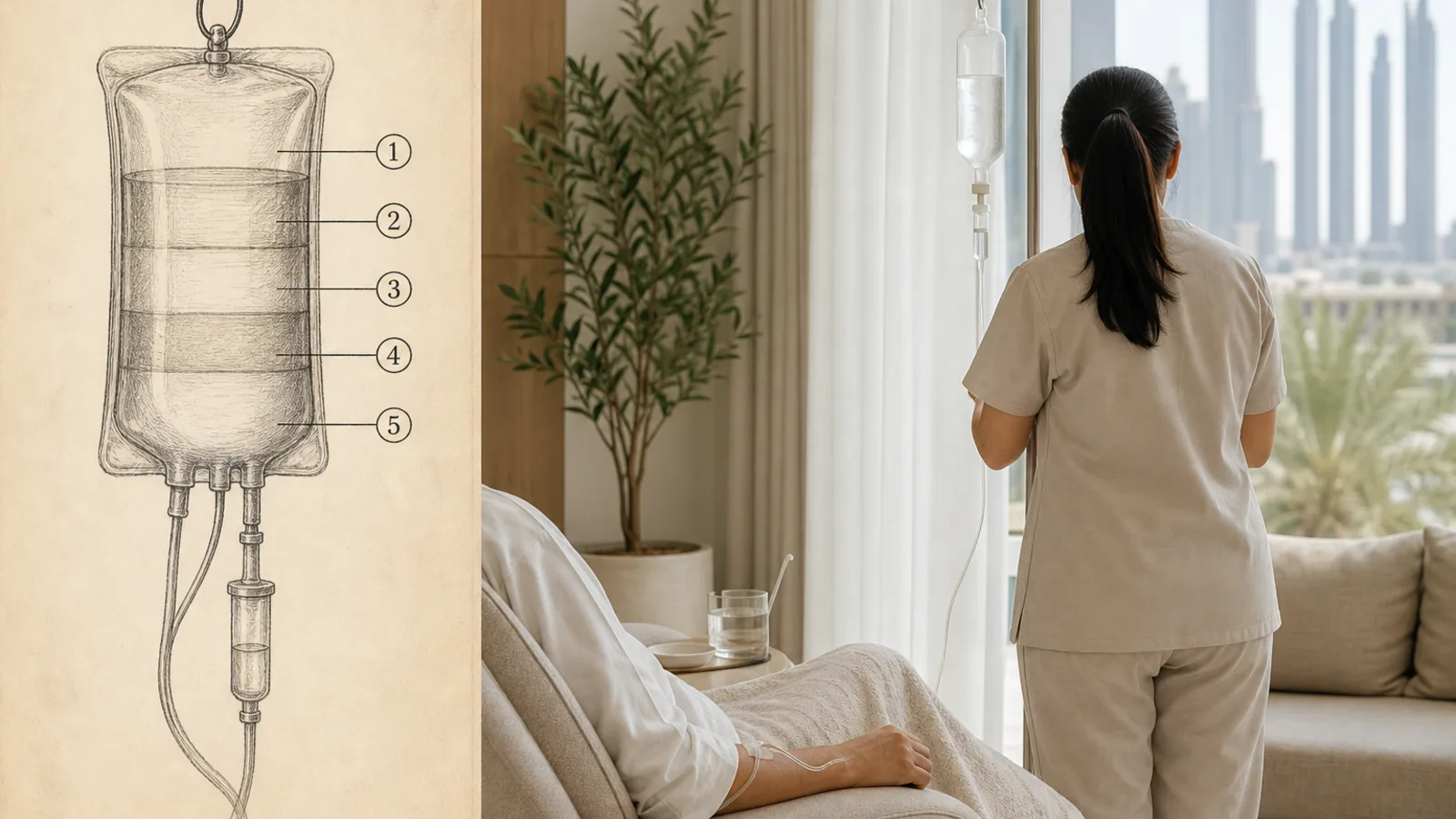
An IV drip in Dubai is a doctor-reviewed mix of saline fluid, vitamins, and minerals delivered through a vein over roughly 45 minutes; at BestDOC, a DHA-licensed nurse runs it at home, with a clinician's sign-off before the bag is ever prepared. It is not a cure for any condition, and it is not a substitute for sleep, food, or a doctor visit when one is needed.
This guide opens the bag. We name what is actually in a standard drip, who it suits and who should skip it, what the published evidence says, what a session at home looks like, and what 22 different drips cost in 2026 AED. Same nurse, same file, no proprietary cocktail names you cannot audit.
Key Takeaways
- BestDOC IV drips in Dubai run from AED 189 (Hydration Express) to AED 1,200 (Iron Boost), quoted upfront by the coordinator before any nurse is dispatched.
- Sessions take 25 to 60 minutes for most drips and up to four hours for the larger NAD+ doses; the nurse arrives in about 45 minutes door-to-door across Dubai.
- Every drip is doctor-reviewed and nurse-administered at home using a sterile single-use kit; BestDOC is DHA-licensed, self-pay, with no insurance paperwork.
- IV drips reliably correct dehydration and documented deficiencies; broader wellness, skin, and anti-ageing claims have limited published evidence.
- Skip or defer if you have kidney disease, congestive heart failure, certain pregnancies, G6PD deficiency, or known allergies to drip ingredients.
What is an IV drip, exactly?
An IV drip delivers fluid, vitamins, and minerals directly into a vein, bypassing the gut and reaching the bloodstream in minutes rather than hours. The carrier is usually 0.9% sodium chloride (saline) or a balanced electrolyte solution; vitamins, minerals, and amino acids are added based on a clinician's prescription. Onset of hydration is rapid, which is why hospitals have used IV fluids for over a century to manage dehydration, post-operative recovery, and electrolyte loss.
In a wellness or recovery setting, the dose and choice of additives are smaller and the purpose is narrower: correct a documented deficiency, restore hydration, or supply nutrients when oral intake is poor. According to Mayo Clinic patient education on dehydration and IV fluids, IV fluid is appropriate when oral rehydration is not tolerated or absorbed. It is a delivery method, not a category of medicine.
| Quick facts | Detail |
|---|---|
| Route | Peripheral vein, usually the forearm or back of the hand |
| Duration | 25 to 60 minutes for most drips; up to 4 hours for high-dose NAD+ |
| Prescribed by | DHA-licensed clinician on a short consult; nurse-administered |
| Volume | Typically 250 to 1,000 ml of carrier fluid per session |
| Setting | At home in Dubai with BestDOC; clinic-based with most competitors |
What is actually in a standard IV drip
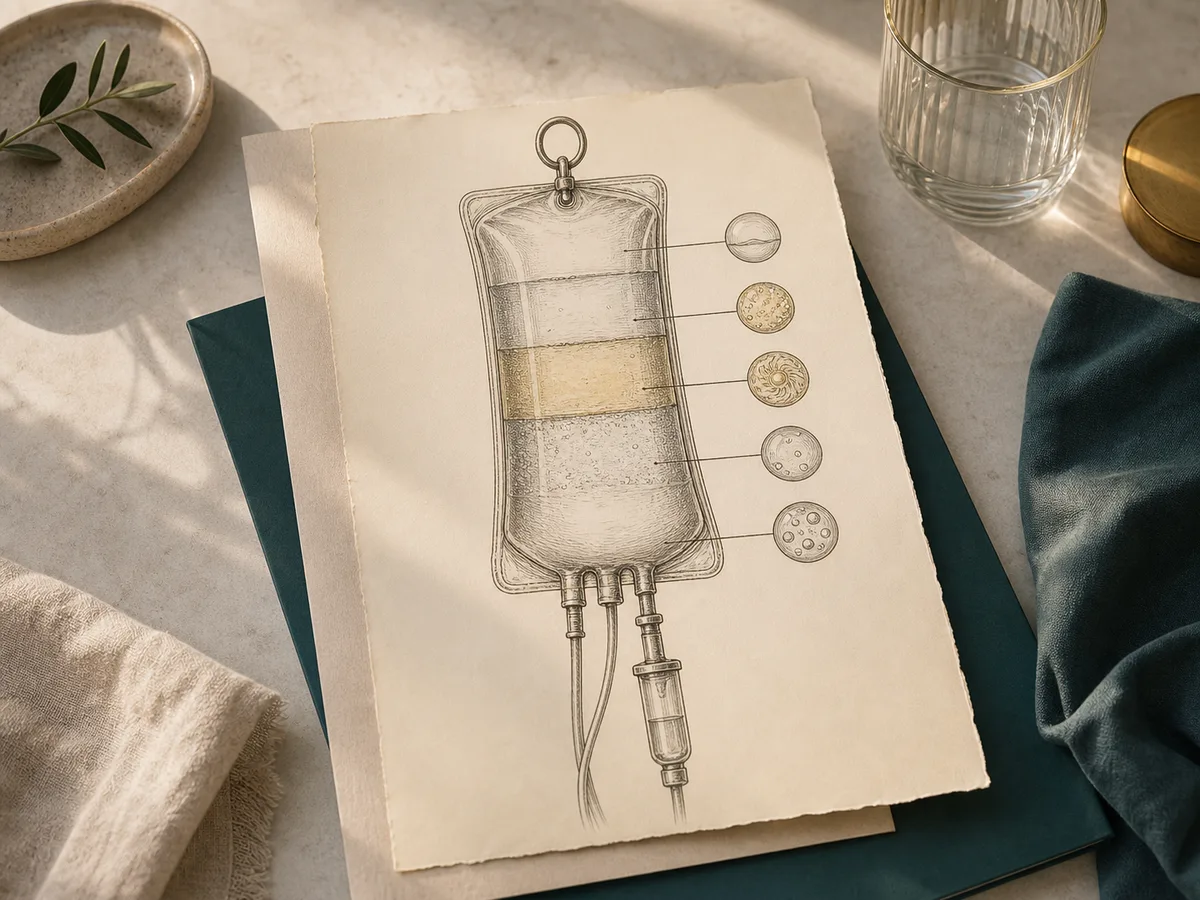
A standard wellness IV drip contains five components: a carrier fluid, electrolytes, B-complex vitamins, vitamin C, and optional add-ons selected by the clinician. The exact recipe shifts with the indication, but the building blocks are remarkably consistent across reputable formulations.
Saline carrier. 250 to 1,000 ml of 0.9% sodium chloride, sometimes a balanced solution such as lactated Ringer's. This is most of the bag. It restores intravascular volume and acts as the vehicle for everything else.
B-complex. A combined dose of B1 (thiamine), B2, B3, B5, B6, and sometimes B12. The NIH Office of Dietary Supplements maintains authoritative fact sheets on each B vitamin, with recommended daily allowances and clinical evidence. IV B-complex is typically used when oral absorption is poor or deficiency is documented.
Vitamin C (ascorbic acid). Doses commonly range from 1,000 to 10,000 mg. The U. S. NIH vitamin C fact sheet notes that IV administration achieves blood levels not reachable orally, but also flags contraindications, including G6PD deficiency for high-dose infusions.
Magnesium and electrolytes. Magnesium sulfate is a common addition for muscle, sleep, and migraine indications. Potassium, calcium, and trace minerals appear in some formulations under clinician sign-off.
Optional add-ons. Glutathione (a tripeptide antioxidant), NAD+ (a coenzyme), iron, zinc, or amino acids. These move the drip from a baseline hydration session into a targeted protocol, and they are where most of the marketing happens.
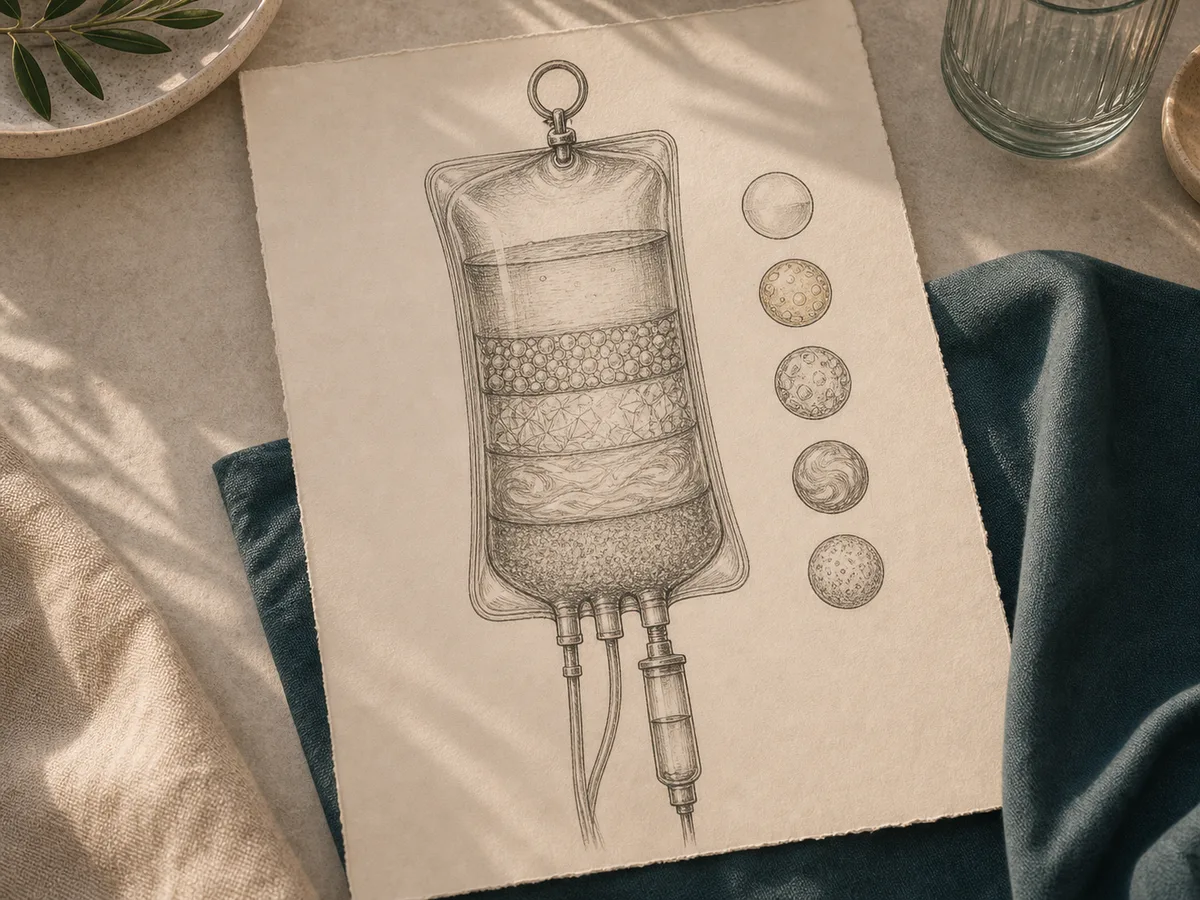
A useful frame: the bag is mostly water. The premium is paid for what is dissolved in it, and whether a clinician has decided you actually need it. That decision is where home IV diverges from a menu order.
Who IV drips are for, and who they are not for
IV drips are suitable for adults with documented dehydration, post-illness recovery, malabsorption, vitamin or mineral deficiency on bloodwork, jet lag, and selected pre-event indications such as travel or athletic recovery. They are not suitable for several groups, and the cautions are not optional.
People with kidney disease (especially CKD stage 3 or higher) cannot clear extra fluid and electrolyte load reliably; volume overload is a real risk. People with congestive heart failure or other fluid-restricted conditions should not receive non-clinical IV fluid without their cardiologist's sign-off. Pregnancy is case-by-case and requires obstetric review; routine wellness drips during pregnancy are not advised in BestDOC's protocol.
G6PD deficiency is a hard stop for high-dose vitamin C IVs; NIH MedlinePlus G6PD guidance explains the haemolytic risk. People on chemotherapy, anticoagulants, methotrexate, or thyroid medication should always disclose their full medication list, because vitamin C, B6, and other components interact with these drugs. Paediatric IV drips for wellness are not a BestDOC service; children with clinical dehydration are managed by a doctor visit and, if needed, hospital referral.
If you fall into any of these groups, the right next step is a short consult with a doctor, not a menu order. BestDOC's coordinator routes these cases to doctor on call for review before any drip is prepared.
Do IV drips actually work? An honest read of the evidence
IV drips reliably do two things: rehydrate, and correct documented vitamin or mineral deficiencies. Beyond that, the evidence thins quickly, and being clear about this is the difference between health information and marketing.
Hydration. Trivially effective. IV saline restores intravascular volume faster than oral fluid and is the standard of care for moderate to severe dehydration, per the WHO oral rehydration guidance and CDC clinical guidance on rehydration.
Vitamin and mineral correction. Effective when deficiency is documented on bloodwork. Iron infusions for anaemia, B12 for documented B12 deficiency, vitamin D in selected cases. Without a deficiency to correct, you are mostly making expensive urine; the body excretes water-soluble surplus.
General wellness, fatigue, and hangover relief. Mixed evidence. A PubMed systematic review of IV vitamin therapy summarises the field as limited, with small studies and methodological weaknesses. The hydration component is the real driver of feeling better; the vitamin add-ons are plausible but not proven.
Vitamin C IV for non-deficiency indications. Outside scurvy and selected oncology research protocols, routine high-dose vitamin C is not established. The U. S. National Cancer Institute reviews the evidence in its IV vitamin C PDQ summary.
NAD+ infusions. Early-stage clinical research. PubMed reviews on NAD+ supplementation describe promising mechanisms in mitochondrial health and cellular ageing, but human trials are small and outcomes preliminary. May support general wellbeing in some users; not established as a treatment for any condition.
Glutathione IV for skin lightening. Not approved by the U. S. FDA or the EMA for this purpose. The Philippine FDA public advisory and U. S. FDA position on compounded IV glutathione both flag safety concerns at high doses. BestDOC offers glutathione as an antioxidant infusion under clinician review; we do not market it as a skin-bleaching product.
The honest summary: an IV drip is a useful clinical tool with a narrow evidence base for wellness use. It can help. It is not magic, and any provider telling you otherwise is selling, not informing.
IV drip side effects and what to watch for
The common side effects of an IV drip are mild and short-lived. The rare ones are serious. Both are worth naming.
Most people experience bruising at the cannula site for two to three days, transient lightheadedness during or just after the infusion, and a cool sensation along the arm as the fluid runs. These are expected and resolve without treatment.
Less common: vein irritation (phlebitis), infiltration if the cannula slips out of the vein, and mild electrolyte shifts if the protocol is mismatched to your physiology. The nurse on case monitors throughout and adjusts the drip rate or stops the infusion if anything is off.
Rare: allergic reaction to a drip component, ranging from mild rash to anaphylaxis in extreme cases. The reported incidence is low, but it is real. BestDOC nurses carry adrenaline and the protocol for this scenario. If you experience breathing difficulty, chest pain, throat tightness, severe rash, or sudden swelling during or after a drip, call 998 for an ambulance immediately and then call BestDOC on +971 800 2378 362.
The Mayo Clinic patient information on IV therapy complications covers the same landscape from a clinical perspective.
IV drip at home versus in a clinic in Dubai
The clinical outcome is the same; the experience is not. Here is the comparison, plainly stated.
| Factor | At home (BestDOC) | In a clinic |
|---|---|---|
| Privacy | Your sofa, your file, no waiting room | Shared lounge or curtained bay |
| Time cost | ~45 min nurse arrival, then session | Travel, parking, check-in, then session |
| Doctor sign-off | Required, before the bag is prepared | Varies by provider; some skip it |
| Sterility | Sealed single-use kit, opened in front of you | Same standard at reputable clinics |
| Continuity | Same nurse on a course, your file kept | Often a different staff member each visit |
| Cost | Same drip prices; no clinic overhead surcharge | Sometimes higher due to facility fees |
| Best for | Family households, post-event recovery, busy schedules | First-ever drip if you prefer clinical setting |
BestDOC is home-only by design. We do not run a lounge. The whole operating model is the nurse coming to you, the doctor reviewing before the visit, and the file staying with the household. If you would rather a clinic, several reputable options exist in Dubai; we will say so on the phone if your case fits a clinic better than home.
How much does an IV drip cost in Dubai?
BestDOC IV drips in Dubai range from AED 189 to AED 1,200 in 2026, with the average wellness drip in the AED 599 to AED 799 band. Prices are quoted upfront by the coordinator; there are no facility surcharges, no menu upcharges at the door, and no insurance approvals to wait on.
| Drip | Price |
|---|---|
| Hydration Express | AED 189 |
| Glutathione IV | AED 299 |
| Vitamin C 1000 | AED 299 |
| Monthly Cycle Relief | AED 499 |
| Hangover Rescue | AED 599 |
| Jet Lag Relief | AED 599 |
| Energy Boost | AED 649 |
| Immunity Support | AED 649 |
| Myer's Cocktail | AED 749 |
| Hair Loss Support | AED 799 |
| Hair, Nails & Skin | AED 799 |
| NAD+ 250mg | AED 799 |
| Iron Boost | AED 1,200 |
On insurance. BestDOC is a self-pay practice. We do not bill insurers directly. This is deliberate: no pre-authorisation queue stands between you and the nurse arriving. You receive a detailed invoice you can submit yourself if your plan reimburses out-of-network home wellness. Most UAE wellness IV is excluded from standard policies, so set expectations there with your insurer first.
Want to compare drips in one view? See the full menu on the IV therapy service hub, where each drip links through to its own page with ingredients, indications, and a booking button.
Which IV drip is right for me? A use-case map
You should not pick a drip from a menu. A clinician should. But here is the map most BestDOC clients land on after their consult, organised by use case, so you arrive at the call already oriented.
| If your situation is… | Drip the doctor often signs off | Direct link |
|---|---|---|
| Hangover or post-event recovery | After Party (AED 599) | Hangover Rescue |
| Post-illness, post-travel immunity | Immunity Booster (AED 649) | IV therapy menu |
| Persistent fatigue, jet lag | Jet Lag Relief (AED 599) | Jet Lag Relief |
| Glow, antioxidant support | Glutathione (AED 299) | Glutathione |
| Longevity, cognitive support | NAD+ 250mg (AED 799) | NAD+ 250mg |
| Iron deficiency, low energy (women) | Iron Boost (AED 1,200) | Iron Boost |
| Plain dehydration | Hydration Express (AED 189) | Hydration Express |
| Athletic recovery, men's wellness | Myer's Cocktail (AED 749) | Myer's Cocktail |
This map is a starting point. The doctor on the consult call may move you to a different drip, change the dose, or recommend bloodwork before any drip at all. That is the point of doctor sign-off.
What an at-home IV drip visit actually looks like
The visit has five steps, and the coordinator walks you through all of them on the booking call. No surprises at the door.
- You book, WhatsApp, toll-free call (+971 800 2378 362), or the short web form. The coordinator takes a brief medical history and asks which drip you are considering or what outcome you want.
- Doctor reviews and signs off, a BestDOC clinician reviews the history, picks or adjusts the drip, and signs the prescription. If your case is not safe for a wellness drip, the coordinator tells you that on the same call.
- Coordinator quotes the price, you know the AED figure before any nurse leaves. No on-arrival upsells, no menu pressure.
- Nurse arrives in about 45 minutes, door-to-door across Dubai. You receive the nurse's name and photo by message before they leave. The kit is sealed and opened in front of you.
- Drip plus observation, then a 7-day check-in, the nurse runs the drip, monitors blood pressure and pulse, and stays for a short post-drip observation. A nurse or coordinator follows up at 24 hours and again within seven days.
The nurse brings a sterile single-use cannula and giving set, a blood-pressure cuff, a pulse oximeter, sharps disposal, and the doctor-signed drip protocol. Nothing is reused, and nothing is shared.
IV drip during Ramadan in Dubai
IV drips during Ramadan are scheduled around the fast, typically after iftar and well before suhoor. Many clients use the immediate post-iftar window for a quick Hydration Express or Hydration + B to restore fluid and electrolytes lost during a long fasting day in the UAE summer.
The rulings on IV during fasting vary by school of thought. The general DHA and MOHAP position is that medically necessary IV fluid is permitted; wellness IV during the fasting hours is a question for your scholar. BestDOC schedules drips to respect your decision, not to second-guess it. Most Ramadan bookings cluster between 9 p.m. and 1 a.m., which is also when our coordinator team runs a dedicated Ramadan rota.
Most-requested Ramadan drips at BestDOC: Hydration Express (AED 189), Hydration + B (AED 189), and Iron Boost (AED 1,200) for clients who fast and notice fatigue by the third week. We will not push longer NAD+ infusions during Ramadan unless you specifically ask; the timing rarely fits the post-iftar window.
Why BestDOC for IV drips in Dubai
We carry the plan; you do not have to. Every drip is doctor-signed before the nurse leaves, every nurse is DHA-licensed, and every kit is sealed single-use. Same nurse on a course, same file across the household, and a coordinator who quotes the price in writing before a visit is booked.
We arrive in about 45 minutes door-to-door across Dubai. If we are late on a confirmed booking, the visit is on us, the "on time, or on us" promise we run for every home call. Self-pay only, no insurance paperwork to slow the visit down. You can read more about how the team is structured on the about page, or talk to a clinician about your case through the doctor on call line.
When the case is a home nursing course rather than a one-off drip, the same continuity rule applies; the home nursing team keeps one nurse on the file from the first visit through the last.
Frequently asked questions
How much does an IV drip cost in Dubai? BestDOC IV drips start at AED 189 (Hydration Express) and go up to AED 1,200 (Iron Boost). The coordinator quotes the price upfront based on the drip the doctor signs off on.
Is an IV drip safe at home? Yes, when administered by a DHA-licensed nurse with a doctor-reviewed prescription, sterile single-use kit, and basic monitoring. People with kidney disease, heart failure, certain pregnancies, or known allergies should consult their doctor first.
How long does an IV drip take? Most drips take 25 to 60 minutes. NAD+ infusions run longer (60 minutes to four hours depending on dose). The nurse stays for the duration plus a short post-drip observation.
Do IV drips really work? They work for hydration and correcting documented vitamin or mineral deficiencies. Evidence for general wellness, anti-ageing, or skin claims is limited; treat marketing language with caution. Always combine with food, sleep, and clinical advice.
Can I get an IV drip during Ramadan? Yes. BestDOC schedules drips around iftar and suhoor. A nurse can administer post-iftar without breaking the next day's fast (subject to your scholar's guidance). Hydration Express and Hydration + B are popular Ramadan choices.
Are IV drips covered by insurance in the UAE? BestDOC is a self-pay practice and does not bill insurers directly. You receive a detailed invoice you can submit yourself if your plan reimburses out-of-network home wellness services.
What are the side effects of an IV drip? Mild bruising at the vein site, brief lightheadedness, and occasional vein irritation. Rarely, electrolyte shifts or allergic reactions. The nurse monitors throughout; call BestDOC or 998 if you have breathing difficulty, chest pain, or severe symptoms afterwards.
Is BestDOC's IV drip nurse DHA-licensed? Yes. Every nurse, doctor, and physiotherapist at BestDOC is DHA-licensed, and the medical director signs off on every drip plan.
Book a doctor-signed IV drip at home
To book or to talk through which drip fits your case, message us on WhatsApp at wa.me/9718002378362, call the toll-free line on +971 800 2378 362 (24/7, every day), or open contact. The coordinator confirms the visit, the doctor signs off, and the nurse arrives in about 45 minutes across Dubai. Same nurse on a course. Same file. We carry it.
Educational. Not medical advice. Consult a licensed clinician before starting any IV therapy. In an emergency, call 998.
Medically reviewed by Dr. Alaa Badawi, MBBS, DHA-licensed, BestDOC Home Healthcare. Last reviewed 22 May 2026.