Allergies in Dubai: Dust, Sandstorms, and How to Manage Them
Allergies in Dubai are driven by three overlapping triggers: fine desert dust that drifts indoors year-round, dust mites that breed in cool, humid air-conditioned bedrooms, and seasonal sandstorms between March and August that push particulate matter well above WHO air quality limits. Symptoms ease with consistent indoor controls, a daily intranasal steroid, and a clinical review if they persist beyond four weeks.
Key Takeaways
- Fine desert dust and pollen drift through Dubai apartments year-round, even in sealed buildings.
- Dust mites are the single most common indoor allergen worldwide and they thrive in UAE bedrooms.
- Shamal sandstorm season (March to August) raises PM2.5 and PM10 far above WHO daily limits.
- Daily intranasal corticosteroid spray is the most effective single treatment for allergic rhinitis.
- See a doctor if symptoms last more than four weeks, disturb sleep, or include wheeze or chest tightness.

What is actually triggering allergies in Dubai
Most Dubai residents who sneeze through the year are reacting to a mix of indoor and outdoor allergens rather than to one single culprit. Sorting the triggers makes treatment much more targeted.
Fine desert dust and outdoor air
Dubai sits in one of the dustiest regions on the planet. Background particulate matter is high even on calm days, and the UAE's own air-quality data shows that annual mean PM2.5 routinely exceeds the World Health Organization's recommended limit of 5 micrograms per cubic metre for long-term exposure (WHO Global Air Quality Guidelines). Fine particles slip through window seals and around door gaps, settle on surfaces, and aerosolize again every time the AC fan kicks on.
Pollen counts in the UAE are lower than in temperate countries, but date palm, ornamental Conocarpus, and grass pollen contribute meaningfully in spring and autumn (Gulf allergen survey, World Allergy Organization Journal).
Indoor dust mites
Dust mites are microscopic relatives of spiders that feed on shed skin and live in mattresses, pillows, sofas, carpets, and soft toys. They are the most common indoor allergen worldwide (Mayo Clinic, Dust Mite Allergy).
Dubai bedrooms are an excellent habitat for them. AC keeps the temperature mite-friendly at 22 to 24 degrees Celsius, and indoor humidity often sits between 50 and 70 percent, the upper end of the comfort zone for mite reproduction. A 2019 review found Gulf households had dust-mite densities comparable to those in tropical Asia, well above European norms (Annals of Saudi Medicine, 2019).
Sandstorm season
From March through August, shamal winds push large dust events across the Arabian Peninsula. On these days, PM10 readings in Dubai can exceed 500 micrograms per cubic metre, more than ten times the WHO daily limit. Across the Gulf, emergency-department visits for asthma exacerbation, allergic rhinitis, and conjunctivitis rise sharply during and immediately after these storms (WHO, Sand and Dust Storms and Health).
If you only have mild background symptoms most of the year and then spend a week in misery in April, sandstorm exposure is almost certainly the reason.
Symptoms worth recognising
Allergic disease in Dubai usually shows up on three fronts. They often appear together, which is why one prescription rarely settles the whole picture.
Nose and sinuses. Sneezing in bursts, clear runny nose, blocked nose, post-nasal drip, and reduced sense of smell. Mouth-breathing at night and a dry throat in the morning are common giveaways in children.
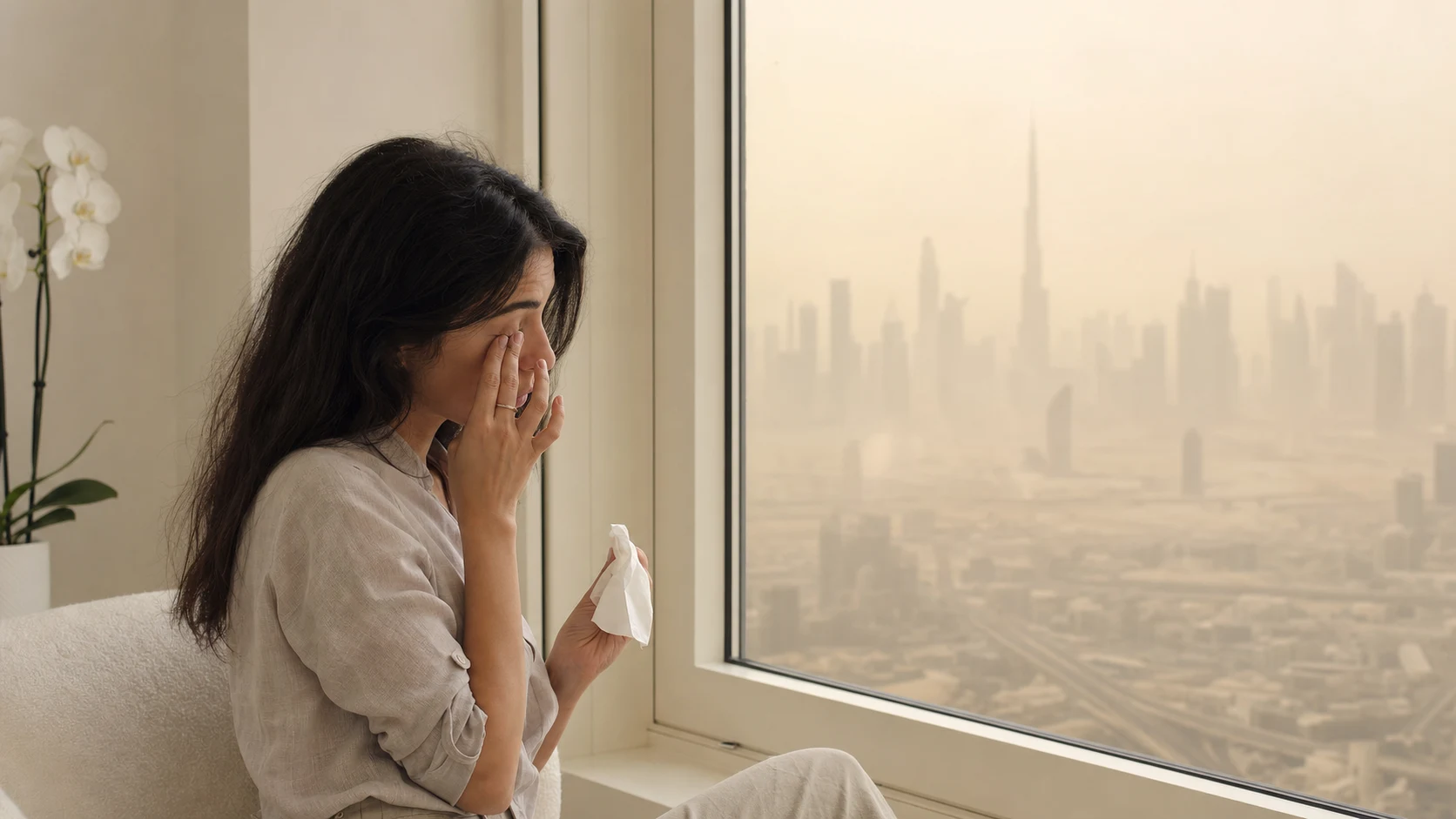
Eyes. Allergic conjunctivitis presents as red, itchy, watery eyes with a gritty feeling, usually in both eyes at once. It is not contagious and does not produce thick pus. The query "red eyes in Dubai" is one of the most common search variants on this topic, and the answer is almost always allergy rather than infection. If your eyes are red, sore, painful to light, or your vision is blurred, see a doctor the same day.
Chest. Allergic triggers are the leading driver of asthma flares worldwide. Wheeze, night cough, exercise intolerance, and a tight feeling when you walk into a dusty room all point to allergic asthma. Anyone with diagnosed asthma should keep a reliever inhaler available and a written action plan reviewed at least once a year, our chronic disease care team can set this up at home.
Skin signs (eczema flares, hives after exposure to a known trigger) are less common but worth mentioning to your clinician because they shift the treatment plan.
When Maya, a marketing director living in Downtown Dubai, finally booked a clinical review in April 2025, she had been waking three times a night for a month with a blocked nose and itchy eyes. Her assumption was a long cold. A short clinical visit found classic allergic rhinitis and conjunctivitis, peaking with the shamal season. Daily nasal steroid, allergen-proof bedding covers, and a new HEPA filter for the bedroom settled her symptoms within two weeks. She has not needed an oral antihistamine since.
How to manage dust allergies at home
Most people get 70 to 80 percent symptom control from consistent home measures plus one or two well-chosen medications. The order matters.
Step 1: reduce exposure where you sleep
The bedroom is the highest-yield room. You spend a third of your life there, and that is where the dust-mite load is densest.
- Encase the mattress, pillow, and duvet in zippered, allergen-impermeable covers.
- Wash bedding weekly at 60 degrees Celsius or higher.
- Keep indoor humidity below 50 percent. Use a hygrometer, AC alone is not enough proof.
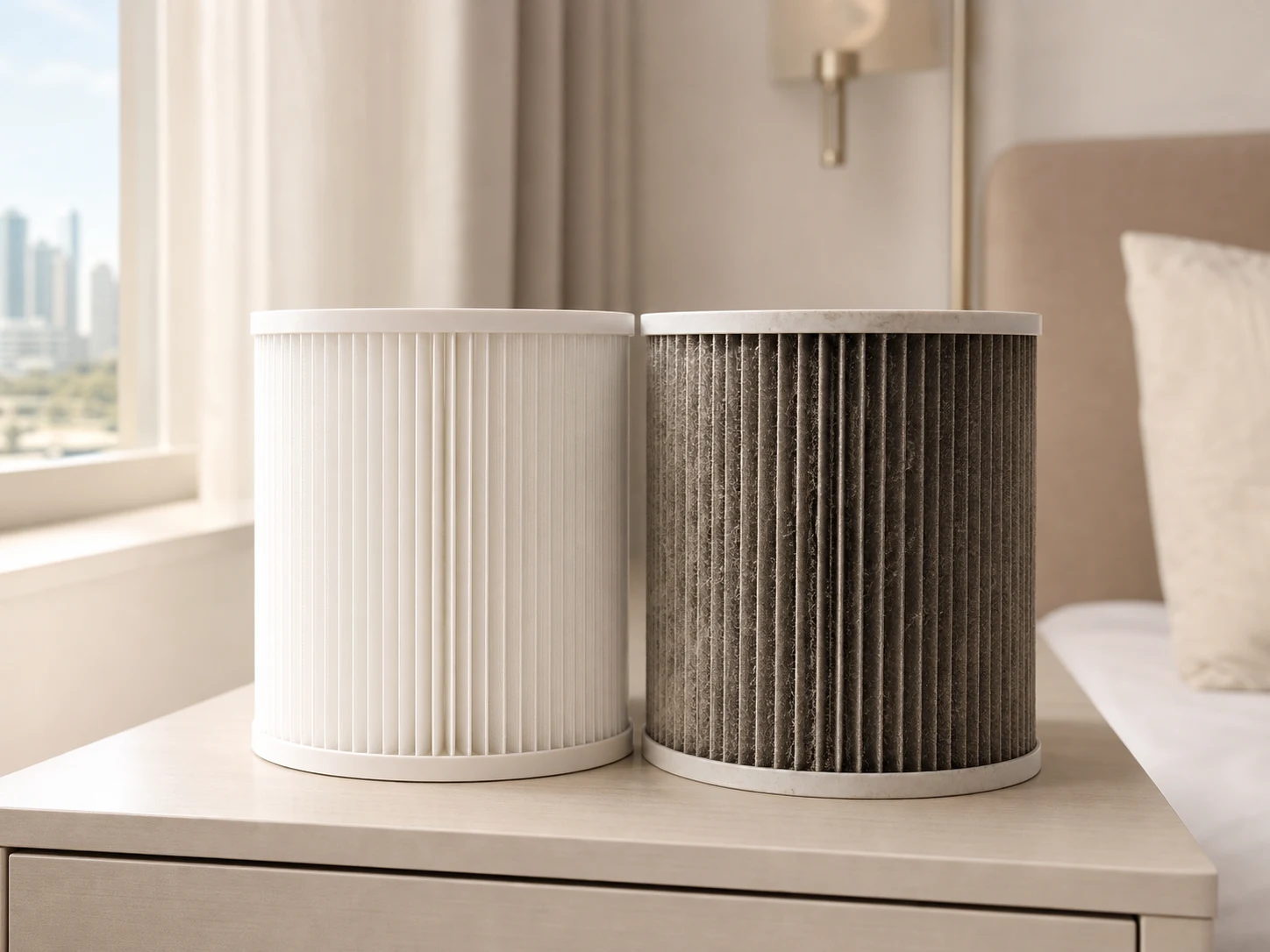
- Replace AC filters every one to three months. Consider a true-HEPA standalone unit for the bedroom during sandstorm season.
- Vacuum carpets and rugs with a HEPA-filter vacuum twice a week. Wet-mop hard floors weekly.
Step 2: medicate consistently, not reactively
International allergy guidelines, including ARIA, place a daily intranasal corticosteroid spray as first-line treatment for moderate-to-severe allergic rhinitis (ARIA 2020 update, Journal of Allergy and Clinical Immunology). Fluticasone, mometasone, and budesonide are all widely available in UAE pharmacies, several without prescription.
A non-sedating oral antihistamine (cetirizine, loratadine, fexofenadine, or desloratadine) handles itch, sneezing, and ocular symptoms. Use it daily through your flare season, not only when you feel bad. For eye symptoms specifically, a dedicated antihistamine eye drop adds a useful layer.
Saline nasal rinses, used once or twice daily, mechanically clear pollen and dust from the nasal lining and complement medication. They are safe in children and pregnancy.
Step 3: plan around sandstorm days
Check the National Centre of Meteorology dust forecast. On heavy-dust days:
- Keep windows and balcony doors shut.
- Run HEPA filtration in the room you spend most time in.
- Wear a well-fitted FFP2 or N95 mask if you must go outdoors.
- Move outdoor exercise indoors.
- Anyone with asthma should pre-empt with their controller inhaler and keep a reliever to hand.

When to see a doctor in Dubai
Home measures handle the majority of cases. Escalate to a clinician when:
- Symptoms persist beyond four weeks despite consistent treatment.
- Sleep is disturbed, work or school is affected, or you are using rescue medication daily.
- You develop sinus pain with fever, facial swelling, or pus from one nostril.
- Wheeze, chest tightness, or shortness of breath appears.
- A child develops persistent night cough, mouth-breathing, or recurrent ear infections.
- Eye symptoms include pain, light sensitivity, or visual change.
A DHA-licensed clinician can examine the airway, run targeted skin-prick or specific IgE blood testing to confirm what you actually react to, and decide whether allergen immunotherapy is worth considering for stubborn cases. Every BestDOC doctor, nurse, and physiotherapist is DHA-licensed and works home visits only, across all of Dubai. For housebound patients, frail elderly relatives, or families who simply prefer continuity of care, a doctor home visit in Dubai lets the same physician examine you and your bedroom on the same morning, and the same clinician stays on your file for follow-up. Where appropriate, prescriptions, allergen testing, and follow-up nursing for nebuliser or injection therapy can be handled through our home nursing team without a second appointment.
For straightforward questions or a medication review between visits, our telemedicine clinic covers most ongoing allergy follow-ups by video.

The shortcut
Allergies in Dubai are rarely a single problem. Fine desert dust, indoor dust mites, and seasonal sandstorms layer on top of each other, and the answer is layered too. Reduce exposure in the bedroom, treat consistently with a daily nasal steroid, plan around shamal days, and book a clinical review if symptoms hold past four weeks. If you would like one of our DHA-licensed physicians to review your case at home, contact BestDOC on the toll-free line +971 800 2378 362 or by WhatsApp, open 24/7, every day, across all of Dubai. We confirm the visit, keep the same care team on your file, and stand behind our "on time, or on us" promise. You can read more about our clinicians on the about page.
For emergencies, call 998. BestDOC is a home healthcare practice, not an emergency service.
Educational. Not medical advice. Consult a licensed clinician for personal guidance.