

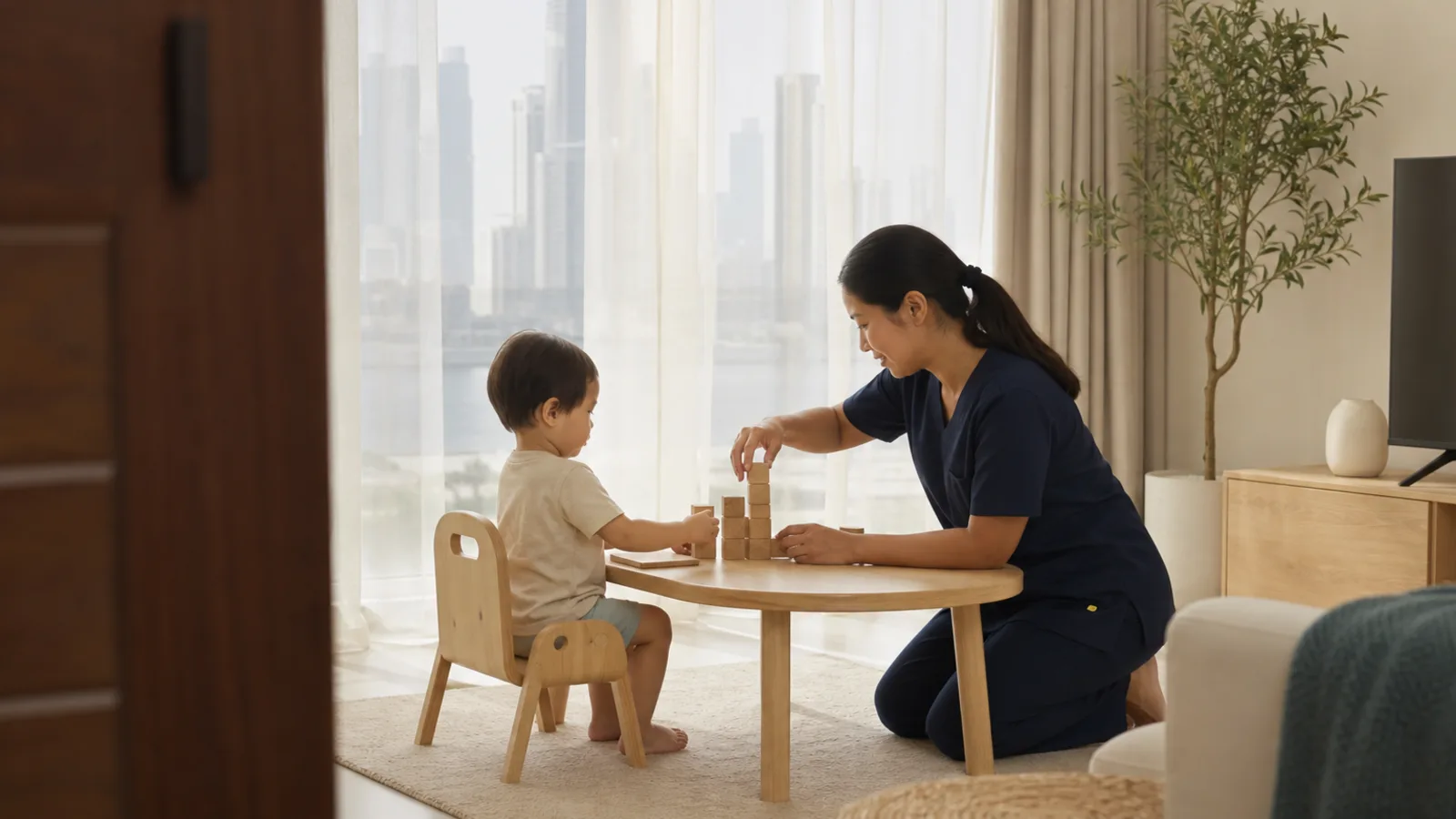
What does a nanny do? Duties, routine and limits in Dubai
A nanny's job is the day-to-day care and development of your child at home: feeding, routine, play, learning and safety, for ages roughly 0 to 12. That is what separates a nanny from a maid, who looks after the household, and from a maternity nurse, who gives clinical care to a newborn in the first weeks.
Most parents hiring for the first time do not really ask what is a nanny. They ask the harder question: what will she own, and what should still sit with me? It is worth getting right in Dubai, where one home often runs a nanny, a helper and, at times, a nurse under the same roof. Here is the real scope, the duties, an hour-by-hour day, the boundaries, how the role shifts with age, and what changes when a nanny is backed by a clinical team.
Key Takeaways
- A nanny owns a child's daily care and development, feeding, routine, play, learning and safety, for ages 0 to 12.
- A nanny is not a maid (no villa-wide cleaning) and not a nurse (no injections, IV or wound care).
- Paediatric first aid and CPR training is non-negotiable for anyone minding young children.
- The job shifts sharply by age, from infant feeds and naps to school runs and homework.
- With BestDOC's Family Care you keep the same nanny each shift, get weekly written reports, and a nurse or doctor can read the same household file.
What does a nanny do? The core duties
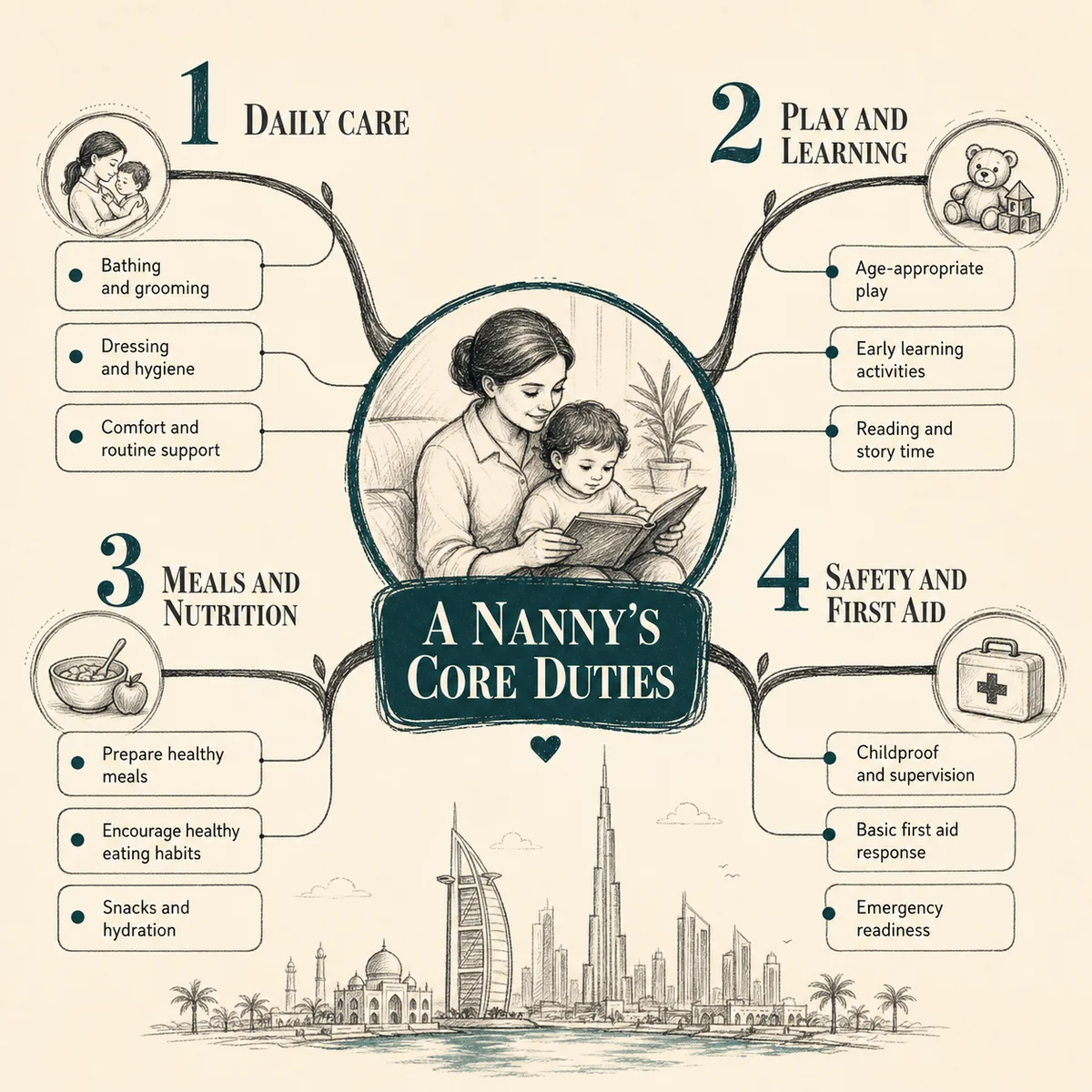
A nanny is responsible for everything to do with the child's waking day, and very little outside it. The role splits into four areas:
- Daily care: feeding, dressing, bathing, nappies, naps and the morning and bedtime routine.
- Play and learning: age-appropriate activities that build language, motor skills and confidence.
- Meals and nutrition: preparing the child's food, managing allergies, and building good eating habits.
- Safety and supervision: constant watchfulness, childproofing, first aid, and a calm head in an emergency.
Around those four sit the practical extras: school runs, homework support, keeping the child's room and toys in order, and washing the children's laundry. What a nanny does not do is run the whole household, and we will come to that boundary in detail below.
Daily care: feeding, dressing, bathing, naps
This is the backbone of the job. A nanny builds a predictable rhythm around the child, the same sequence of meals, naps and wind-downs each day, because young children settle far better on routine than on improvisation. For an infant that means feeds, nappy changes and sleep cues, including safe-sleep practice, which the CDC sets out as a core way to lower sleep-related risk. For a toddler it means getting dressed, brushing teeth, and learning to do small things alone.
Play, learning and development
Play is not filler. The World Health Organization frames responsive play and early stimulation as core to healthy brain development in the first years, not an optional extra. A good nanny reads to the child, sets up messy and imaginative play, narrates the day to build vocabulary, and follows the child's lead rather than parking them in front of a screen. The American Academy of Pediatrics makes the same case for play as the work of childhood, and knowing the CDC's developmental milestones helps a carer pitch activities to the child's stage rather than guessing.
Meals and nutrition for children
A nanny plans and prepares the child's meals and snacks, not the adults' dinner. That covers age-appropriate portions, managing any allergy or intolerance to the letter, and modelling calm, unhurried mealtimes. For babies it may mean preparing bottles and, later, introducing solids on the parents' instructions.
Safety, first aid and emergencies
Supervision is the duty that never switches off. The most common serious incidents for young children at home, choking, falls, burns and drowning, are exactly the ones where the first minutes decide the outcome. The CDC lists these as leading causes of child injury, which is why current paediatric first aid and CPR training is not a nice-to-have. Ask for proof of it before anyone starts.
Hiring soon? See how a nanny fits inside BestDOC's Family Care in Dubai, where every carer is trained before you ever meet her.
A nanny's day, hour by hour
The honest answer to "what does a nanny do all day" depends entirely on the child's age. Two sample days show how different the same job can look.

When Maya, a working mother in Dubai Marina, hired her first nanny for her eight-month-old, she expected a list of chores. What she got instead was a rhythm: the same feeds, the same nap windows, the same nanny, every day. Three weeks in, the baby was sleeping through, and Maya was reading the weekly report on her phone at lunch instead of guessing how the morning had gone.
| Time | Day with an infant (0–1) | Day with a school-age child (6–10) |
|---|---|---|
| Morning | Feed, nappy, dress, supervised floor play | Wake, breakfast, uniform, school run |
| Midday | Feed, nap, tidy the nursery | Collect from school, lunch, homework |
| Afternoon | Walk or play, second nap, feed | Activities, reading, snack |
| Evening | Bath, bottle, bedtime routine | Dinner prep for the child, bath, bedtime |
A day with a newborn or infant
Infant days run on short, repeating cycles of feed, play, sleep. The nanny tracks feeds and nappies, keeps the nursery in order, and protects sleep windows. If your newborn needs clinical attention rather than daily care, that is a different role, covered under newborn care and maternity care, not a nanny's scope.
A day with a school-age child
Here the job pivots to logistics and learning: the school run, homework support, after-school activities and a calm path to bedtime. The cooking, cleaning and supervision all narrow to the child.
What a nanny is not responsible for
This is the section parents search for most, and the one agencies skip. Knowing the limits protects everyone and keeps the contract honest.
- Villa-wide cleaning. A nanny tidies the child's room and toys; deep-cleaning the whole home is a maid's or housekeeper's job.
- Cooking for the adults. She prepares the child's meals, not the family's dinner service.
- Errands unrelated to the child. Grocery runs, dry-cleaning and admin sit outside the role.
- Any clinical task. Injections, wound dressing, IV drips and managing a sick child's medication belong to a DHA-licensed nurse. If a child needs hands-on medical care, that is home nursing, not nannying.
Blurring these lines is the fastest way to lose a good nanny. A clear scope, agreed up front, is what keeps the role sustainable.
Nanny vs maid vs maternity nurse, who does what
Three roles, often confused, with very different training and scope.
| Role | Primary focus | Typical scope |
|---|---|---|
| Nanny | The child (0–12) | Care, routine, play, learning, child-related tidying |
| Maid / housemaid | The household | Cleaning, family laundry, adult cooking, errands |
| Maternity nurse | The newborn (clinical) | Feeding support, infant health, recovery support in the early weeks |
A fuller breakdown of the clinical side lives in our guide to a DHA-licensed maternity nurse versus a nanny. The short version: a nanny develops a child; a nurse delivers clinical care.
Duties by a child's age (0–12)
The single biggest factor in what a nanny does is how old the child is. The role re-shapes itself roughly every few years.
0–12 months
Feeds (breast-milk, bottles, then first solids on instruction), nappies, naps, safe floor play, and close tracking of sleep and feeding. Calm, consistent handling matters more than activities at this stage.
Toddler (1–3)
Mealtime independence, potty training, language through constant narration, and a lot of supervised physical play. Boundaries and routine become the daily work.
4–8 years
School or nursery runs, early homework, structured play, social skills, and managing the after-school come-down. The nanny becomes part teacher, part coach.
9–12 years
More logistics than hands-on care: schedules, activities, homework supervision and emotional support as the child grows more independent. The relationship shifts from carer to trusted adult.
Full-time, part-time or live-in, how the role changes
The duties stay the same; the coverage changes.
- Full-time nannies cover the child's whole waking day and are the norm for two working parents.
- Part-time nannies handle defined blocks, the school run, afternoons, or specific weekdays.
- Live-in nannies offer the widest cover, including evenings and early mornings, within agreed, humane hours.
Cost varies with hours, experience and live-in arrangements. We do not list a fixed figure here because it depends on your family's needs, so contact BestDOC for a quote rather than a guess.
How a nanny works at BestDOC
Here is the part no standalone agency can match. A BestDOC nanny is not a lone hire, she sits inside a DHA-licensed home-care practice. That changes three things.
First, continuity: you keep the same nanny each shift, the same hands your child already trusts, again next week and the week after. Second, visibility: you receive weekly written reports on the child's day, so nothing is left to guesswork. Third, and this is the one that matters most at 2am, clinical backing: because your nanny is on the same household file as our nurses and doctors, a child who spikes a fever is not left to a nanny improvising alone. A DHA-licensed clinician can step in on the same file.

Our nannies care for children aged 0 to 12, hourly, by shift, or live-in, across all of Dubai. Every one is trained before a family meets her, and the medical director stands behind the practice. You can read more about our DHA-licensed team and what that licensing means.
Ready to arrange one? Tell us your hours and your child's age and we will match a nanny and quote upfront. Talk to BestDOC's Family Care team, or WhatsApp the 24/7 line on +971 800 2378 362.
The bottom line
A nanny owns your child's day: the feeding, the routine, the play, the learning and the safety, scaled to the child's age. A good one stays in her lane, no villa cleaning, no adult cooking, no clinical tasks, and a great one is backed by a system rather than left to cope alone. If you want the same nanny each shift, written reports, and a nurse and doctor on the same file, that is exactly how Family Care is built. Start with BestDOC's child care in Dubai.
Educational content, not medical advice. For any clinical concern about your child, consult a licensed clinician. BestDOC is a DHA-licensed home-healthcare practice serving all of Dubai. Not an emergency service, for emergencies call 998.