


Vitamin D Test Results Explained: What Your Number Means
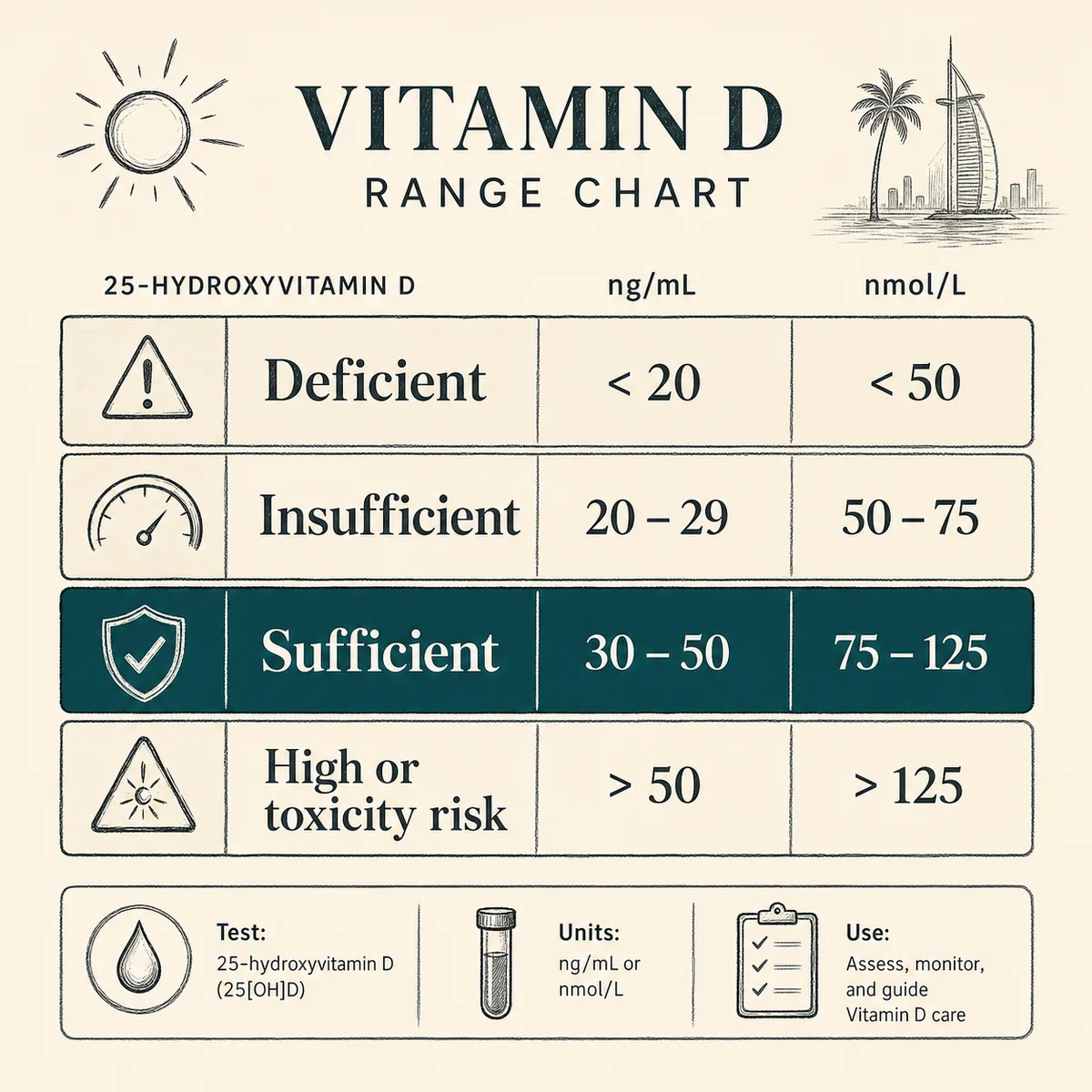
If your result came back as a number like 18 ng/mL or 45 nmol/L, here's the short version: below 20 ng/mL (50 nmol/L) is deficient, 20-29 ng/mL (50-72 nmol/L) is insufficient, and 30-100 ng/mL (75-250 nmol/L) is sufficient. The rest of this guide covers the units, why two tests can disagree, and what to actually do next.
Key Takeaways
- Deficient is below 20 ng/mL (50 nmol/L); insufficient is 20-29 ng/mL (50-72 nmol/L); sufficient is 30-100 ng/mL (75-250 nmol/L).
- UAE labs report in ng/mL or nmol/L, multiply ng/mL by roughly 2.5 to get nmol/L.
- Two tests can disagree because of lab method, timing, or biotin supplement interference.
- Retesting after starting a supplement usually happens at 8-12 weeks, not sooner.
- A telemedicine review (AED 100) or GP home visit can walk you through what your specific number means.
Reading your number: units and ranges
Labs measure 25-hydroxyvitamin D, written as 25(OH)D. It's the storage form of the vitamin circulating in your blood, and it's the number every reference range below is built on.
UAE labs report this in ng/mL or nmol/L, and the two aren't interchangeable without conversion. Roughly, ng/mL × 2.5 = nmol/L. So 20 ng/mL is about 50 nmol/L, and 30 ng/mL is about 75 nmol/L.
| Result | ng/mL | nmol/L |
|---|---|---|
| Deficient | Below 20 | Below 50 |
| Insufficient | 20-29 | 50-72 |
| Sufficient | 30-100 | 75-250 |
| High / toxicity risk | Above 100 | Above 250 |
These are the ranges used by the NIH Office of Dietary Supplements. Some clinicians aim higher within the sufficient band, closer to 30-50 ng/mL, rather than treating 30 as a finish line. Pregnancy and childhood use the same lab ranges, but the clinical target and monitoring schedule differ, that's a conversation for your clinician, not a number to self-interpret.
This video walks through how a 25-hydroxyvitamin D result gets scored, including what counts as low or high: Vitamin D Test Explained - Results, Low & High Values.
Want a doctor to read your specific result against your history? Book a home vitamin D test or have an existing result reviewed by telemedicine.
Why two vitamin D tests can disagree
It's one of the most common sources of confusion, and almost nobody explains it: your number can shift between two tests that were only weeks apart, even without any real change in your vitamin D status.
Three things usually explain it. Labs can use different assay methods, and those methods don't always agree exactly. Your level also reflects recent sun exposure and how recently you took a supplement dose. And if you take high-dose biotin, common in hair, skin, and nail supplements, it can distort some immunoassay-based vitamin D tests, according to a 2025 review of assay interference. Mention any biotin supplement to your nurse before the draw.

Layla, a Dubai-based teacher, tested at 17 ng/mL in March 2026 and 24 ng/mL six weeks later at a different lab, with no supplement change in between. Confused, she booked a telemedicine review. The doctor traced it to a lab-method difference and set one consistent testing path going forward. Her third result, at the same lab, tracked steadily upward.
What to do next, based on your result
Deficient (below 20 ng/mL): your clinician sets a supplement dose based on your level and history. Retest is typically at 8-12 weeks to confirm it responded, per an expert consensus statement on repletion.
Insufficient (20-29 ng/mL): usually managed with lifestyle changes and a monitoring plan, with your clinician setting the retest interval.
Sufficient (30-100 ng/mL): maintain what you're doing; an annual recheck is typical.
Above 100 ng/mL: flag it for clinical review. Reaching this level without high-dose supplementation is unusual, and it's worth ruling out before assuming it's fine.
Deficiency itself is common across the region, not just in people who avoid the sun, one UAE-based review of local prevalence data found it widespread even among otherwise healthy adults.

Whatever tier you land in, the same next step applies: get the number read against your actual history. A telemedicine review (AED 100) walks through your report with a doctor by video. If your symptoms need a fuller work-up, a doctor home visit (from AED 300, free 7-day follow-up) covers that. Every BestDOC lab result is read by a DHA-licensed doctor, not handed over as a raw PDF.
FAQ
What's a normal vitamin D level? Sufficient is generally 30-100 ng/mL (75-250 nmol/L). Below 20 ng/mL (50 nmol/L) is deficient.
Why did my two tests give different numbers? Lab method, timing since sun or supplement exposure, and biotin interference are the three usual causes.
How long until a supplement raises my level? Most clinicians retest at 8-12 weeks after starting or adjusting a dose.
Do I need to fast for this test? No.
Is vitamin D toxicity common? No, it's rare, and almost always from sustained high-dose supplementation, not sun or diet.
Can I get my results explained without a clinic visit? Yes, by telemedicine review.
A vitamin D result on its own is just a number. What matters is the tier it falls in and what happens next. Book a home vitamin D test or have your last one reviewed by a doctor, same DHA-licensed team, same file, every time. Read more about BestDOC's home healthcare team, or get in touch to book.
Educational. Not medical advice. Consult a licensed clinician.