
Stretch Marks During Pregnancy: What Helps, What Doesn't, What's Safe
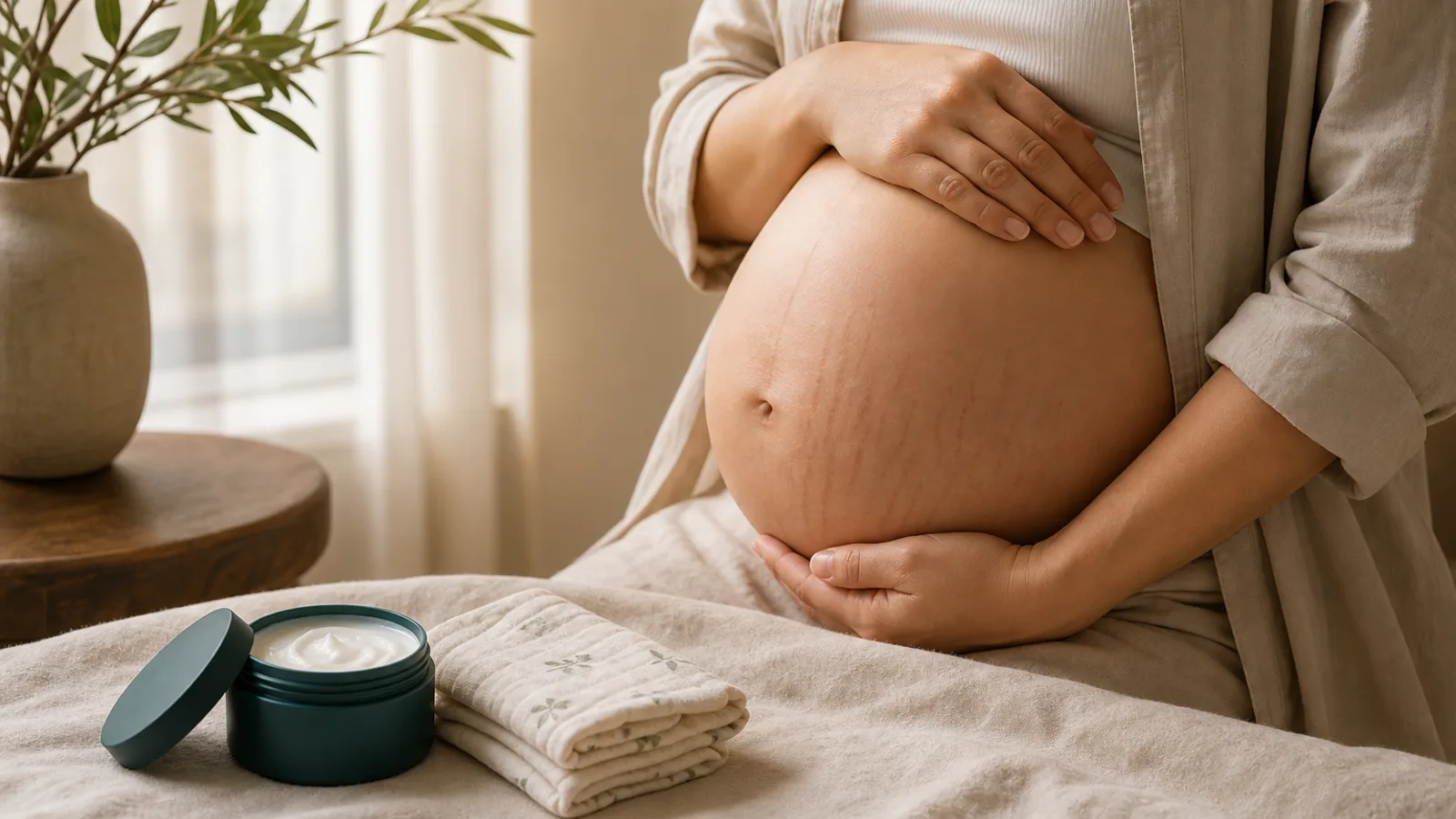
Stretch marks during pregnancy are normal marks that appear as your skin stretches to make room for your baby, and no cream is proven to prevent them. They show up on the belly, breasts, hips and thighs, usually in the second or third trimester, and most fade on their own in the months after birth.
If you have noticed faint pink or purple lines tracking across your bump, you are in good company. Most pregnant women get them, and getting them says nothing about how well you are looking after yourself. This guide walks you through why they happen, what the evidence actually supports, which products are safe to use while pregnant, and what realistic recovery looks like.
Key Takeaways
- Stretch marks (striae gravidarum) affect most pregnancies and are completely normal.
- No cream or oil is proven to prevent them, confirmed by a Cochrane review of around 800 women.
- Daily moisturising, massage, hydration and gradual weight gain support skin comfort, not a guarantee.
- Avoid retinoid and tretinoin products while pregnant or breastfeeding.
- Most marks fade from red or purple to silver within 6 to 12 months after birth.
What are stretch marks during pregnancy?
Stretch marks during pregnancy, known clinically as striae gravidarum, are small tears in the middle layer of the skin (the dermis) that form when it stretches more rapidly than it can comfortably adapt. They start as red, pink or purple streaks and slowly settle into paler, slightly sunken lines.
They tend to appear where the body grows the most: the lower belly, breasts, hips, thighs and sometimes the lower back. For most women they arrive in the second or third trimester, often from around the 24th week, when the bump grows most rapidly.
Pregnancy makes them more likely for two reasons at once. The skin is stretching rapidly, and pregnancy hormones soften the collagen and elastin fibres that give skin its bounce. According to the NHS, this combination is why so many women develop them, and why they are nobody's fault.
Why do some women get them and others don't?
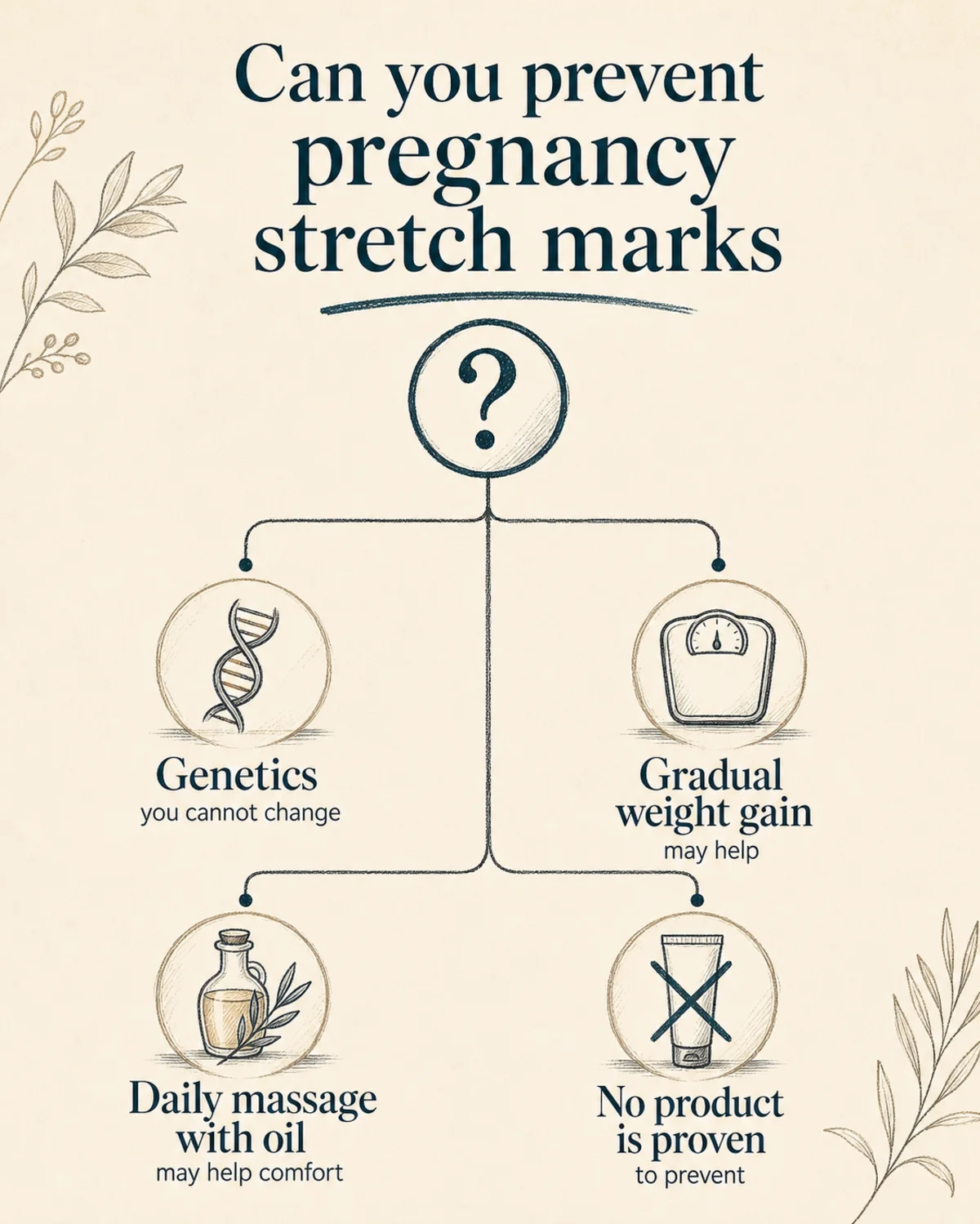
The single strongest predictor is genetics. If your mother or sisters had stretch marks in pregnancy, you are more likely to as well, regardless of what you put on your skin.
Other factors that raise the odds include rapid or large weight gain, being younger, carrying a larger baby or more than one, and how well your skin holds hydration. Estimates vary, but the research puts the figure at roughly 50% to 90% of pregnant women developing some degree of striae, which tells you just how ordinary they are.
Here is the honest part most pages skip: you can do everything "right", gain weight slowly, moisturise daily, drink your water, and still get them. And you can do very little and walk away mark-free. That is the genetic lottery at work, not a reflection of effort.
Can you prevent stretch marks during pregnancy?
Not reliably. A [Cochrane review](https://www.cochranelibrary.com/cdsr/doi/10.1002/14651858. CD000066.pub2/abstract) of six trials covering roughly 800 women found no high-quality evidence that any topical product prevents stretch marks. That is the most rigorous answer available, and it is worth trusting over any single bottle's marketing.
That does not mean nothing helps your skin feel better. It means the honest framing is comfort and care, not prevention. Here is what the evidence actually supports.
| Method or ingredient | What the evidence says | Verdict |
|---|---|---|
| Cocoa butter | Trials show no clear benefit over placebo | Won't prevent |
| Bio-Oil / mixed oils | Popular, widely used, little proof of prevention | Comfort only |
| Almond oil with massage | Lower rates in one trial, credited to the massage | The massage may help |
| Centella asiatica | One older trial showed reduced incidence | Limited, promising |
| Hyaluronic acid | Some signal in small studies | Limited evidence |
| Hydration + gradual weight gain | Supports skin and overall health | Sensible, supportive |
The thread running through the research is that the act of massaging the skin for a few moments a day may matter more than the specific product in your hand. A gentle daily massage with any plain oil or moisturiser keeps skin supple and gives you a calm moment with your bump.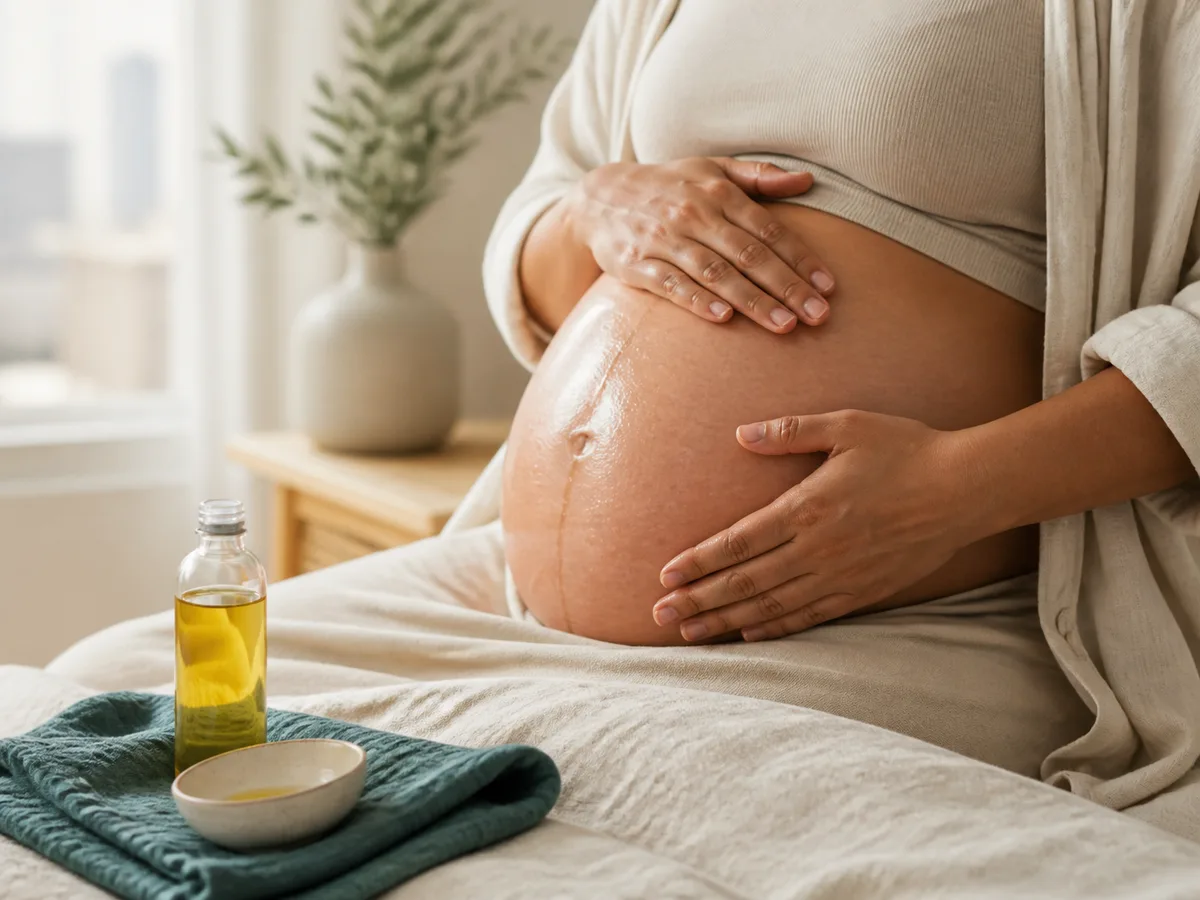
One safety point that matters more than any cream: avoid retinoids, tretinoin and high-dose topical vitamin A while you are pregnant or breastfeeding. Mayo Clinic notes these ingredients are used for stretch marks after pregnancy, but they are not considered safe during it. If a product lists "retinol", "retinyl" or "tretinoin", set it aside until your clinician clears you.
Want a clinician to look over your pregnancy skincare and comfort routine at home? A DHA-licensed clinician can review it with you on a single home visit. See maternity care at home →
Do pregnancy stretch marks go away?
They fade, but they rarely vanish. In the first weeks after birth, fresh marks often look their most obvious, red, pink or purple, because the small tears are still settling.
Over the following 6 to 12 months they typically lose their colour and shift to a paler silver or white, and they flatten as the skin recovers. The American Pregnancy Association describes this same gradual fade. The lines may still be visible up close, especially in certain light, and that is the normal end point for most women.
When Layla, a first-time mother in Dubai, finished her pregnancy in early 2025, the deep purple marks across her lower belly worried her. Her maternity nurse reassured her they would settle, and by her baby's first birthday they had paled to soft silver lines she barely noticed. Nothing dramatic fixed them. Time, gentle moisturising and a little patience did the work.
Treatment after pregnancy
Once your skin has healed and your doctor has cleared you, a few options can soften the appearance of older marks. These are dermatology and aesthetic clinic procedures, not maternity care, and they include topical retinoids, fractional laser, microneedling, radiofrequency and chemical peels. In Dubai, a course usually runs across three to five sessions and roughly AED 599 to AED 3,499 depending on the method.
Two honest caveats. First, results vary and no treatment promises full removal; peer-reviewed analyses of laser therapy for striae report fractional lasers improve the appearance of older marks only partially, not erase them. Second, if you are breastfeeding, several of these are postponed until you have finished and your clinician agrees, so timing is a medical decision, not a cosmetic one.
In the meantime, the pregnancy-safe approach stays simple: keep the skin moisturised, protect newer marks from strong sun, and give your body the months it needs. There is no rush, and there is nothing to fix about a normal body that grew a baby.
How BestDOC supports you through pregnancy and recovery
Stretch marks are a skin change, not a medical problem, but the pregnancy and the months after it deserve real support. That is the part BestDOC carries for you, with DHA-licensed clinicians who come to your home.
- Maternity care at home. A maternity nurse through pregnancy and the postnatal weeks, with the same hands on your case visit after visit, so you are not re-explaining yourself to a stranger each time.
- Prenatal physiotherapy. Pregnancy-safe prenatal physiotherapy for circulation, posture and comfort as your body changes and your centre of gravity shifts.
- Postnatal and newborn support. Practical newborn care at home in the early weeks, plus post-surgical rehab if you are recovering from a C-section.
To be straight with you: BestDOC does not do cosmetic laser stretch-mark removal. We look after the mother's health and recovery, and the cosmetic decision is yours, on your own timeline, with a dermatologist you choose. What we carry is the care around you and your baby.
Ready to set up care at home? Call our toll-free line +971 800 2378 362 or message us on WhatsApp, any day, any hour, anywhere in Dubai. Talk to us about maternity care at home or reach the team and we will take it from there.