

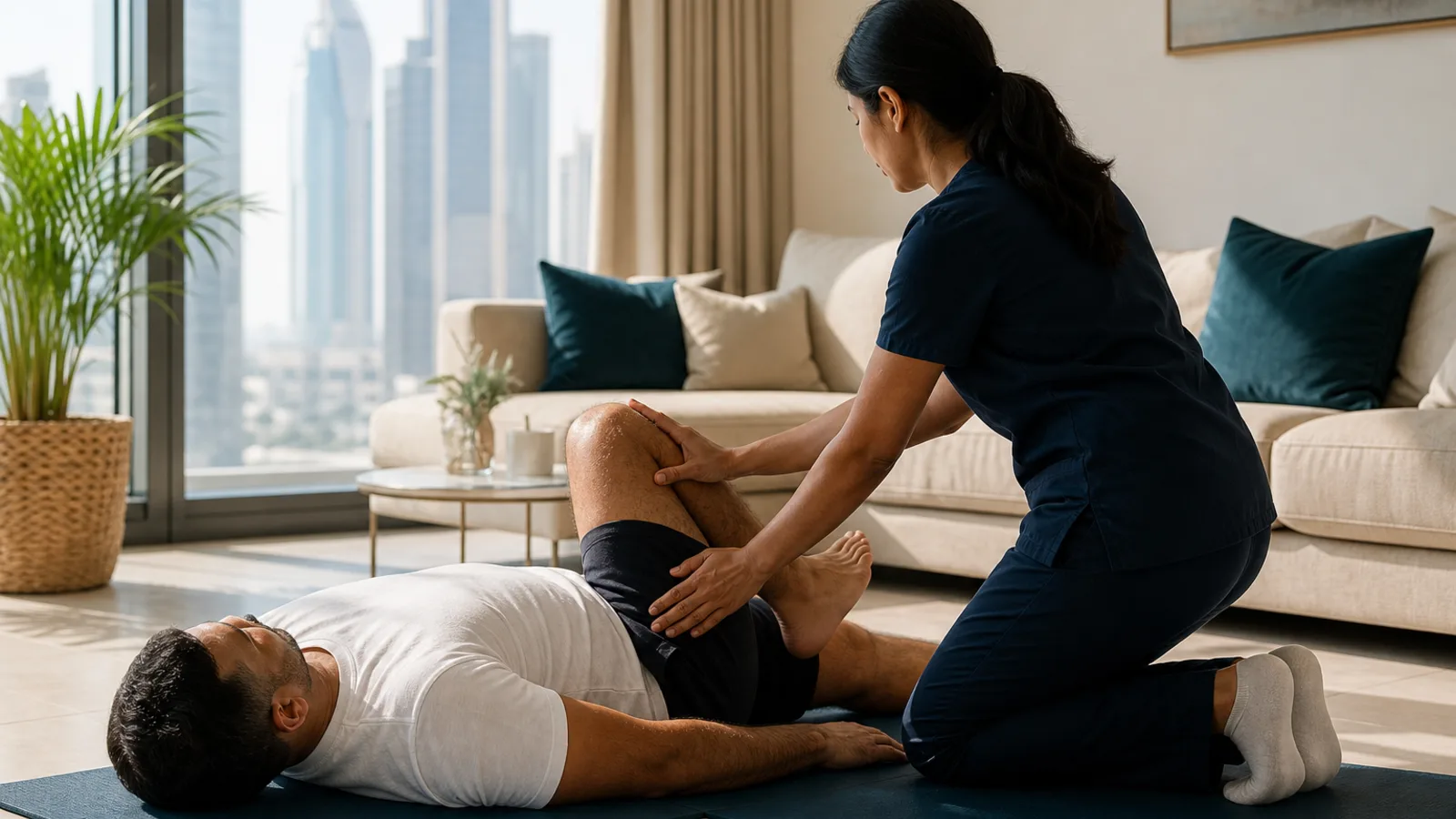
Physiotherapy resolves most cases of sciatica without injections or surgery; research puts it at around 80 to 90 percent of people. In Dubai you can now have that sciatica physiotherapy delivered at home, which matters most in the acute phase, when sitting in a car and waiting on a clinic chair is exactly what hurts.
You already suspect the pain running from your lower back down one leg is sciatica, and you want it gone without rushing into surgery. This guide explains how physiotherapists actually treat it, the exercises that help, honest cost and timeline numbers for Dubai, and the red flags that mean you need a clinic, not a mat at home.
Key takeaways
- Sciatica is compression of the sciatic nerve, usually from a herniated disc; pain travels from the lower back down one leg.
- Physiotherapy is the recommended first-line treatment, and most cases improve in four to eight weeks without surgery.
- Core methods are the McKenzie approach, nerve gliding, core stabilisation, and manual therapy, matched to your cause.
- BestDOC sends a DPT, MSc Speech Therapy, German-certified Lymphedema Physiotherapist, DHA & MOH licensed to your home, the same physio across the whole course, from AED 350 a session.
- Red flags, numbness in the groin, loss of bladder or bowel control, or weakness in both legs, are emergencies. Call 998.
What is sciatica, and why does it happen?
Sciatica is not a diagnosis on its own. It is the set of symptoms, pain, tingling, or numbness, that appear when something presses on the sciatic nerve, the largest nerve in the body, running from the lower back through each buttock and down the leg.
The most common cause is a herniated disc in the lumbar spine, where the soft centre of a disc bulges and irritates the nerve root. According to Mayo Clinic, other causes include spinal stenosis, a narrowing of the spinal canal, and bone spurs. Sciatica is common: studies cited by the National Institutes of Health suggest a large share of adults experience it at some point in life.
Why Dubai routines aggravate it
The triggers we see at home in Dubai are rarely dramatic. Long commutes down Sheikh Zayed Road keep the spine loaded in one position. Desk-bound office days do the same. Weekend gym sessions, heavy deadlifts and lifting with a rounded back, are the other frequent culprit.
None of these "cause" a herniated disc on their own, but they stack the load on an already sensitive lower back. That is why sciatica so often flares on an ordinary Tuesday morning rather than during the workout itself.
Can physiotherapy actually fix sciatica?
For most people, yes. The large majority of sciatica cases settle with conservative care and never reach an operating theatre. The UK's NICE guideline on low back pain and sciatica recommends exercise and physiotherapy as first-line treatment, ahead of imaging or surgery, for cases without red-flag signs.
Physiotherapy works by taking pressure off the nerve and restoring normal movement, not by masking pain. A physiotherapist identifies the direction and cause of your compression, then prescribes the specific movements that decompress it, while teaching you how to load the spine safely again.
Not sure whether your back pain is sciatica or a muscle strain? A home assessment with a DPT, MSc Speech Therapy, German-certified Lymphedema Physiotherapist, DHA & MOH licensed sorts that out before you start any exercise. Explore home physiotherapy in Dubai →
How physiotherapists treat sciatica
A good sciatica programme is rarely one technique. Your physiotherapist combines a few, and adjusts the mix as your symptoms change week to week.
- McKenzie method (MDT). Directional exercises, often spinal extension, that move pain out of the leg and back toward the spine, a sign the nerve is decompressing.
- Neural mobilisation (nerve gliding). Gentle movements that help the sciatic nerve slide freely through the tissues instead of catching.
- Core stabilisation and motor control. Retraining the deep abdominal and back muscles to support the spine so the disc is loaded less.
- Manual therapy and pain modulation. Hands-on mobilisation and soft-tissue work to ease the muscle guarding that comes with nerve pain.
The point of a course, rather than a single session, is that these are layered in order. Continuity matters here: the same physiotherapist who saw how your leg pain behaved in week one is the one who knows whether week three is genuinely better.

Physiotherapist-approved sciatica exercises to start at home
These are gentle starting points that many people tolerate well. Move slowly, breathe, and stop if pain shoots further down the leg, that means the exercise is wrong for your cause, not that you need to push harder.
- Knee-to-chest stretch. Lying on your back, draw one knee gently toward your chest, hold, and lower. Eases tension in the lower back.
- Sciatic nerve glide. Sitting, slowly straighten one knee and flex the ankle, then release. Helps the nerve move freely.
- Prone press-up (extension). Lying face down, press up onto your forearms or hands, keeping hips down. A core McKenzie movement for disc-related pain.
- Glute and piriformis stretch. Cross one ankle over the opposite knee and draw the legs toward you to release the buttock muscle.
- Pelvic tilt. Gently flatten the lower back into the floor and release, building deep core control.
- Bird-dog. On hands and knees, extend the opposite arm and leg, building stability without loading the spine.
One honest caveat: these have to be matched to your cause. Extension helps many herniated discs but can aggravate spinal stenosis. That is the difference a physiotherapist's assessment makes. The NHS demonstrates cause-specific versions in this short guide:
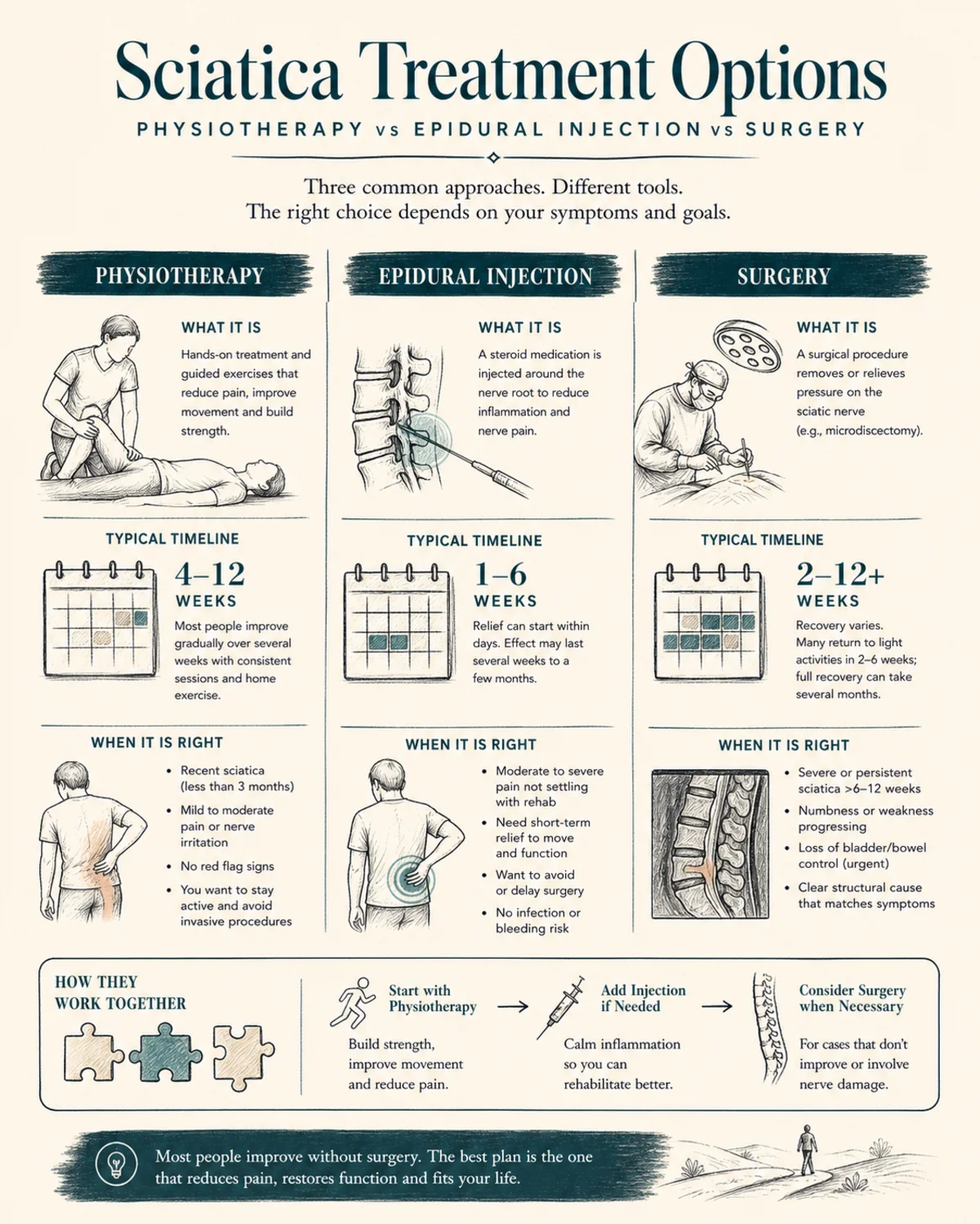
Physiotherapy vs injection vs surgery for sciatica
Most people want to know where physiotherapy sits against the alternatives. The honest answer is that it comes first, and the others are there for the minority who need them.
| Path | What it is | Typical timeline | Typical Dubai cost (AED) | When it is right |
|---|---|---|---|---|
| Physiotherapy | Hands-on therapy plus a tailored exercise course | 4–8 weeks for acute cases | From 350 a session; course commonly cited around 2,000–5,000 | First-line for nearly all non-red-flag sciatica |
| Epidural injection | Steroid injected near the nerve root to reduce inflammation | Relief in days, often temporary | Contact a spine clinic for a quote | Severe pain not settling with physio alone |
| Surgery (e.g. discectomy) | Surgical decompression of the nerve | Weeks to months of recovery | Contact a spine clinic for a quote | Persistent severe cases or clear nerve damage |
The pattern is consistent with the NICE guidance: start conservative, escalate only if it fails. If back pain stems from a sports or lifting injury, a structured sports and pain management course can run alongside the same plan.
Want a clear path instead of guesswork? A physiotherapist can assess you at home and tell you honestly whether you need a clinic or a course of physio. Talk to a clinician about your case →
How long does sciatica take to heal with physiotherapy?
For acute sciatica, expect meaningful improvement within four to eight weeks, in line with NHS guidance. Many people feel the leg pain start to retreat toward the back, the encouraging sign physios look for, within the first couple of weeks.
Chronic or disc-related sciatica takes longer and is usually run as a course of six to twelve sessions, with home exercises between visits. Healing is rarely linear; a flare after a good week is normal, not a failure. What matters is the overall trend across the course.
When Rami, a 41-year-old project manager in Business Bay, woke with pain shooting from his lower back down his right leg, he could not face the drive to a clinic, let alone the wait. A DPT, MSc Speech Therapy, German-certified Lymphedema Physiotherapist, DHA & MOH licensed came to him instead. The same physio ran seven sessions across six weeks, adjusting the plan each visit, and by week seven he was walking the Marina loop again without the leg pain.

When sciatica is an emergency: red flags
Most sciatica is not dangerous, but a small set of signs means you should not wait for physiotherapy. Seek emergency care if you have numbness around the groin, buttocks, or inner thighs, loss of bladder or bowel control, or weakness in both legs.
These can indicate cauda equina syndrome, a rare but serious compression that needs urgent surgical assessment, as the NHS warns. Call 998 or go straight to a spine clinic. BestDOC is a home healthcare practice, not an emergency service.
Sciatica physiotherapy at home with BestDOC
Here is what a home course looks like with us. A DPT, MSc Speech Therapy, German-certified Lymphedema Physiotherapist, DHA & MOH licensed comes to your home anywhere in Dubai and runs the full programme there, the same physiotherapist every visit, so nothing about your case gets re-explained to a new face.
Before exercises begin, a doctor at home can screen for the red flags above, confirm the diagnosis, and prescribe if needed, without a separate hospital trip. Then your physio takes over the course. Sessions start from AED 350 for 60 minutes, with a full sciatica course quoted as a package. You pay an honest price agreed upfront, with no insurance paperwork in the way.
Every clinician is licensed by the Dubai Health Authority and signed off by our medical director. To book, message us on WhatsApp or call the toll-free line, +971 800 2378 362, with coordination available 24/7 across all of Dubai. Common questions are answered on our FAQ page.
The short version
Sciatica is sciatic-nerve compression, usually from a herniated disc, and physiotherapy fixes it for the large majority of people without surgery. The work is matching the right exercises to your specific cause, running a proper course rather than a one-off, and screening the red flags first. In Dubai, you no longer have to travel through the worst of the pain to get that care.
If your back-and-leg pain has lasted more than a few days, start with an assessment. Book home physiotherapy in Dubai with BestDOC, the same physio across your whole course, and let us carry the recovery from here.
Educational content, not medical advice. Sciatica can have serious causes; consult a licensed clinician about your symptoms. Reviewed by Dr. Omar Khalil, MBBS, MD Internal Medicine, DHA-licensed, Medical Director, Best DOC Home Health Care L.L.C.