

Postnatal Meaning: What 'Postnatal' Really Refers To
Postnatal means "after birth". It describes both the time after delivery and the medical care that mother and newborn receive during that window, usually the first six weeks. Most clinicians, including those at the DHA and the WHO, use "postnatal" to cover the pair together, where "postpartum" usually refers to the mother alone.
Key Takeaways
- "Postnatal" comes from Latin post (after) and natalis (of birth). It applies to mother and newborn.
- The WHO defines the postnatal period as the first six weeks after delivery.
- ACOG extends postpartum care to twelve weeks, the "fourth trimester".
- In the UAE, the Arabic forty-day arba'een tradition closely overlaps the clinical postnatal window.
- About 60% of maternal deaths occur during the postnatal period, which is why the six-week check is non-negotiable.
What does "postnatal" mean?
The word comes from Latin: post meaning "after" and natalis meaning "of birth". In a clinical setting, postnatal describes the recovery and check-up period that begins the moment a baby is delivered and continues for at least six weeks.
It applies to both people in the room. The mother's body goes through uterine involution, perineal or c-section healing, hormonal reset, and emotional adjustment. The newborn is screened, weighed, fed, and observed. When a doctor's note, hospital discharge summary, or app uses the word "postnatal", it is referring to this paired window for mother and baby, as defined by the World Health Organization.
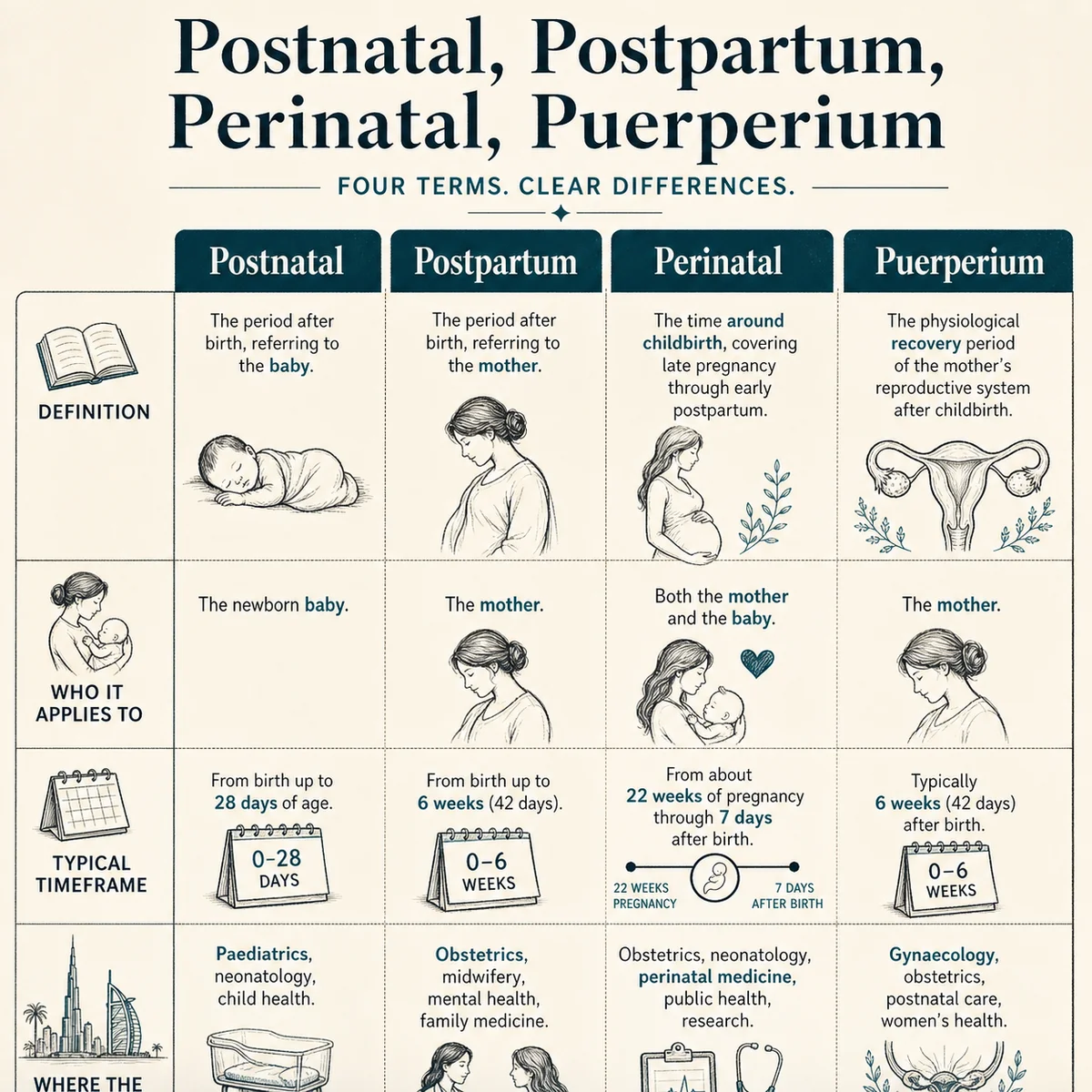
Postnatal vs postpartum vs perinatal vs puerperium
These four words are often used interchangeably, which can confuse a tired new parent reading a discharge sheet at 2 a.m. They are not identical.
| Term | What it means | Applies to | Typical timeframe |
|---|---|---|---|
| Postnatal | After birth | Mother and newborn | First 6 weeks (WHO) |
| Postpartum | After delivery | Mother specifically | First 6 to 12 weeks (ACOG) |
| Perinatal | Around the time of birth | Pregnancy through first week after delivery | Late pregnancy to day 7 |
| Puerperium | Old clinical term for the recovery phase | Mother specifically | First 6 weeks |
UAE clinicians, working under DHA standards, tend to write "postnatal" and "postpartum" interchangeably on the same note. If your discharge summary uses one word in one place and the other a paragraph later, this is why.
How long is the postnatal period?
The WHO sets the postnatal period at six weeks from delivery. This is the window in which most physical healing happens and where most maternal complications are caught at the six-week check.
The American College of Obstetricians and Gynecologists takes a broader view. In Committee Opinion 736, ACOG redefined postpartum care as an "ongoing process" through twelve weeks, sometimes called the "fourth trimester". The longer frame covers mental health, contraception planning, and chronic conditions that surface after delivery. Both definitions are valid. The six-week mark stays the clinical anchor; the twelve-week frame is the safety net.

Postnatal care for the mother
For the mother, postnatal care is a structured set of checks across six weeks. The body has to undo nine months of work.
- Uterine involution: the uterus shrinks back toward its pre-pregnancy size, usually within four to six weeks.
- Lochia: postnatal vaginal discharge that lasts four to six weeks, per Mayo Clinic.
- Perineal or c-section healing: stitches reviewed, pain managed, infection ruled out.
- Six-week postnatal check: blood pressure, weight, abdominal exam, contraception conversation.
- Mental health screening: the Edinburgh Postnatal Depression Scale (EPDS) is the standard tool; an estimated 10 to 15% of mothers experience postpartum depression.
- Feeding and lactation review: latch, supply, nipple pain, breast or formula plan.
Consider Layla, a first-time mother in Jumeirah who delivered by c-section in early March. By week three her lochia had nearly stopped, but her incision was still tender and her sleep was broken. Her BestDOC home nurse came twice that week, reviewed the wound, ran an EPDS screen, and flagged a low score that triggered an extra check-in by Dr. Mahnoor. The six-week visit confirmed full healing and a contraception plan. That is what structured postnatal care looks like.
Want this delivered at home in Dubai? Explore DHA-licensed maternity care at home, where the same nurse follows your case across the full six weeks.
Postnatal care for the newborn
The newborn track runs in parallel. The first six weeks decide feeding patterns, sleep, and early developmental flags.
- Cord care and umbilical stump review until it falls off, usually by day 14.
- Jaundice screen in the first week, with a transcutaneous bilirubinometer or blood test if needed.
- Weight checks at day three, day seven, and again at six weeks. A healthy newborn regains birth weight by week two.
- Newborn screening (heel-prick) for metabolic and endocrine conditions, plus hearing screen, both per NHS protocol and DHA standards.
- Feeding support: breast, mixed, or formula. Volume, frequency, and weight gain reviewed together.
- First vaccinations: BCG and Hepatitis B at birth, then the next round at six weeks per the UAE schedule.
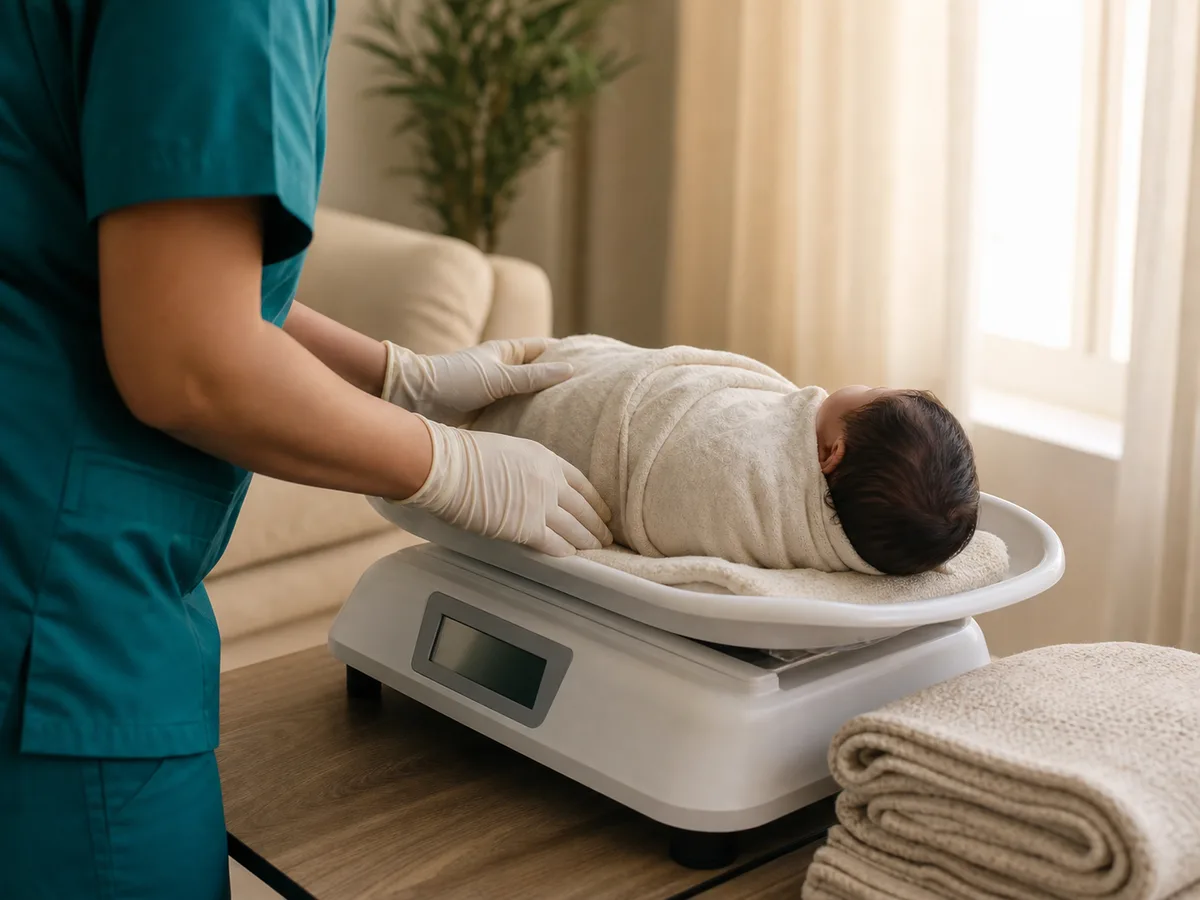
If you want both tracks handled by the same team, newborn care after delivery folds the baby's checks into the mother's six-week timeline.
"Postnatal" in the UAE: clinical and cultural framing
UAE discharge summaries default to "postnatal" because it covers both patients in a single word. The clinical frame is the WHO six-week window, paired with the DHA's Maternal and Child Health Standards, which require a postnatal visit within those first six weeks.
The cultural overlay is the Arabic arba'een, the forty-day confinement also called nifas. The mother stays home, family carries the household, food and rest are prioritized, and visitors are limited. Forty days is just under six weeks, so the cultural practice and the clinical guideline line up almost exactly. They are not in conflict: the arba'een is the rest, the postnatal check is the medicine.
A home-based model fits this overlap. The mother does not have to leave the house for a clinic visit; the clinician travels to her. At BestDOC, gender-matched nurses and Ramadan-aware visit windows are part of the default schedule, not a special request.
When to call a clinician during the postnatal period
The postnatal period is mostly recovery, but a few red flags require a same-day clinical review. Do not wait for the six-week check if any of the following appear.
- Heavy bleeding (soaking more than one pad per hour) or large clots.
- Fever above 38°C, or chills.
- Severe headache, blurred vision, or chest pain (possible postnatal pre-eclampsia).
- Breast pain with fever (possible mastitis).
- A red, swollen, or hot calf (possible deep vein thrombosis).
- Low mood, intrusive thoughts, or anxiety lasting more than two weeks.
- In the newborn: yellowing skin past the first week, poor feeding, fewer than six wet nappies a day, or a fever.
For any of these, contact a doctor the same day, or call +971 800 2378 362 (BestDOC, 24/7, all of Dubai). Emergencies (heavy uncontrolled bleeding, seizures, an unresponsive baby) go directly to 998.
Frequently asked questions
What does postnatal mean in simple terms? Postnatal means "after birth". It describes the period, and the care, that follows delivery for both mother and newborn.
Is postnatal the same as postpartum? They overlap. "Postnatal" covers both mother and baby; "postpartum" refers specifically to the mother. UAE clinicians use the two interchangeably on most discharge notes.
How long is the postnatal period? WHO defines it as six weeks. ACOG extends postpartum care up to twelve weeks, the "fourth trimester".
What is included in a postnatal check? Blood pressure, healing of stitches or c-section, uterine involution, mood screening, contraception, and a newborn growth and feeding review.
What is the difference between postnatal and perinatal? Perinatal spans late pregnancy through the first week after birth. Postnatal begins at delivery and continues for at least six weeks.
Does the Arabic forty-day period count as postnatal care? Culturally yes. The arba'een matches the WHO six-week window. Clinical postnatal care, the six-week check, newborn screening, and vaccinations, should still happen within it.
Closing
"Postnatal" is the medical label for the first six weeks after birth, for both mother and newborn. Use the word with confidence on a discharge sheet or in a clinician conversation; ask which definition (WHO six weeks or ACOG twelve weeks) your care plan follows.
If you would like the six-week window covered at home by the same nurse, with the doctor review built in, see DHA-licensed maternity care at home, home nurse for postnatal recovery, and prenatal and postnatal physiotherapy. For the clinical team behind these visits, read about BestDOC's clinical team, or contact us directly on +971 800 2378 362 or WhatsApp.
Educational. Not medical advice. Consult a licensed clinician.
Reviewed by Dr. Mahnoor Asif, MBBS, DHA-licensed, Maternity and Newborn Care Lead, BestDOC Home Healthcare. Last reviewed: 22 May 2026.