

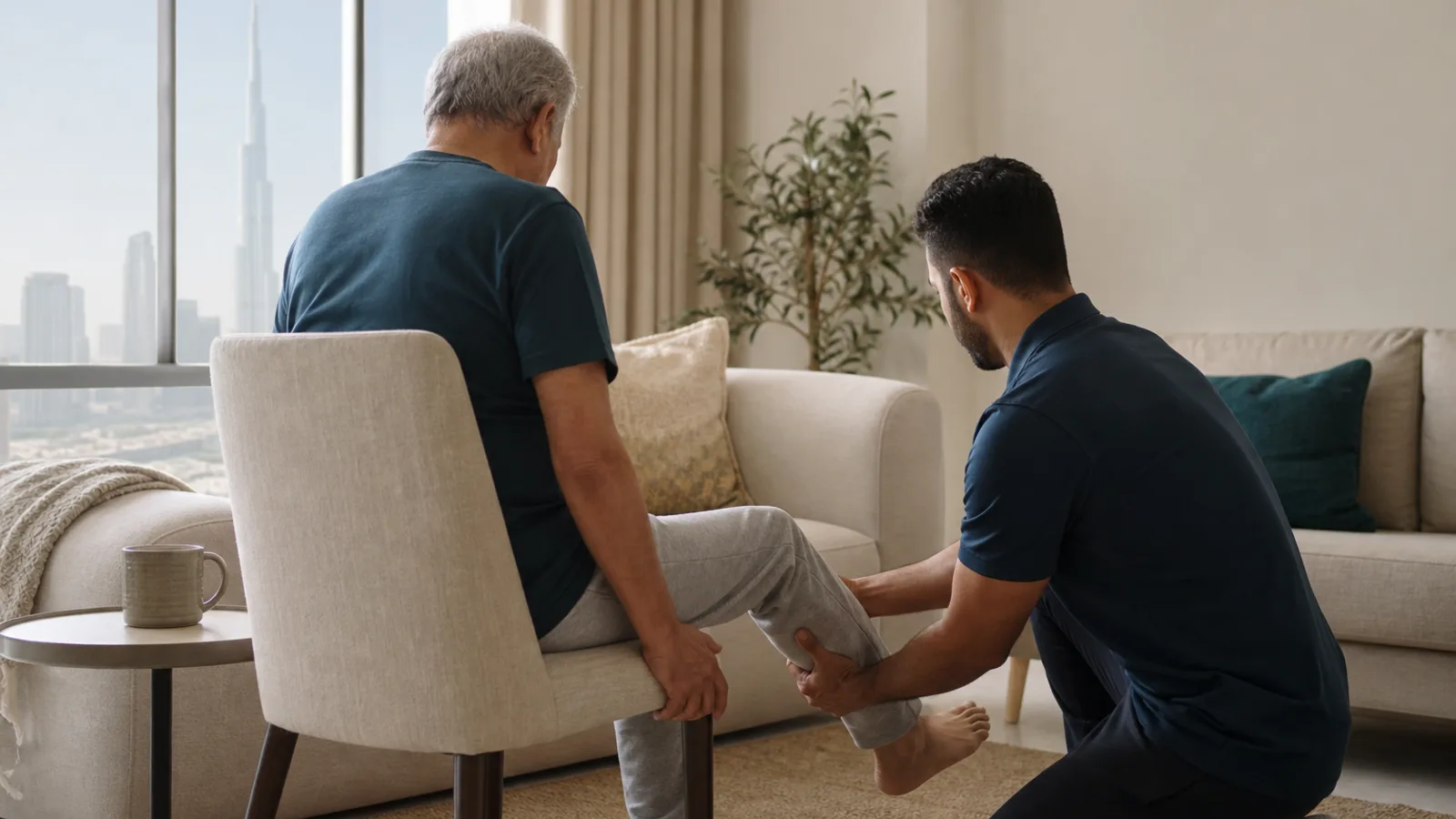
Physical therapy after total knee replacement: a home recovery guide
Physical therapy after total knee replacement starts within 24 hours of surgery and runs for roughly 6 to 12 weeks, built around one main job: getting your knee to bend and straighten again. Do the daily exercises, hit your range-of-motion targets, and most people regain about 75% of normal function by month three.
You already know the surgery is only half the work. The other half is the weeks that follow, and that part is yours to win. This guide walks you through when therapy begins, the three phases of rehab, a week-by-week recovery timeline, the exercises that actually move the needle, and the warning signs worth a call to your surgeon. It is written for patients recovering at home in Dubai, where a home physiotherapist in Dubai can bring the whole programme to your living room.
Key Takeaways
- Physical therapy begins within 24 hours of surgery and typically runs 6 to 12 weeks.
- The main goal is range of motion: about 90° to sit, 120° for stairs, and full extension to 0°.
- Most people regain around 75% of function by month 3; full recovery can take up to 12 months.
- Your daily home exercises matter more than the number of clinic visits.
- A DHA-licensed home physiotherapist in Dubai brings rehab to you, from AED 300 a session, with the same physio every visit.
When does physical therapy start after a knee replacement?
It starts almost immediately. Most patients stand and take their first guided steps within 24 hours of surgery, often the same day, before they leave the hospital (PMC).
Early movement is not about being brave. It lowers the risk of blood clots, keeps the new joint from stiffening, and gives your muscles a head start. A physiotherapist will have you doing gentle ankle pumps and short walks while you are still on the ward. The work you begin in those first hours sets the ceiling for everything that follows.
The three phases of knee-replacement rehab
Rehab moves through three overlapping phases. Knowing which one you are in keeps your expectations realistic.
Phase 1, in hospital (day 0 to 2)
The focus is safety and motion. You will learn to stand, walk with a frame, and manage a few stairs, while a physiotherapist starts gentle range-of-motion work. The Cleveland Clinic notes that getting up and moving early is one of the strongest predictors of a smooth recovery.
Phase 2, first weeks at home
This is where most of the work happens, and where many patients are on their own. The goal shifts to restoring bend and straightening, walking longer distances, and weaning off the walker. Wound checks and swelling control matter here too, which is why some families pair physio with a DHA-licensed home nurse for dressing changes in the first week or two.
Phase 3, outpatient or strengthening (weeks 6 to 16)
Once motion returns, the work turns to strength and stamina. According to Hospital for Special Surgery, the model runs roughly range of motion in weeks 0 to 6, then strengthening through weeks 6 to 16, with about 75% of function back by month three.
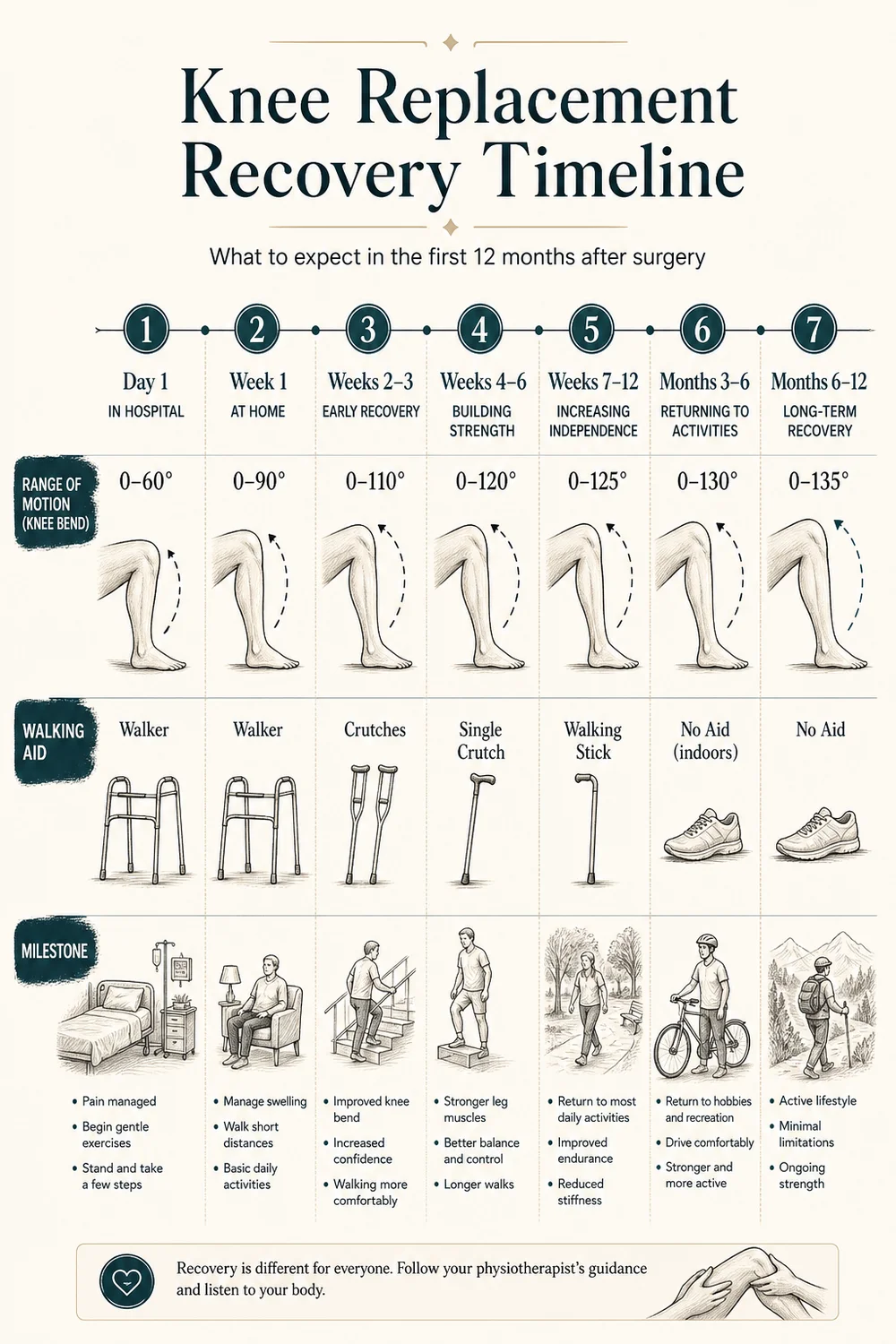
Knee replacement recovery timeline, week by week
Recovery is gradual but predictable. Use this as a map, not a deadline: your surgeon and physiotherapist set the pace for your knee.
| Stage | Range-of-motion goal | Walking aid | Activity milestone |
|---|---|---|---|
| Day 1 | 0–40° | Walker | Stand, take first steps |
| Week 1 | ~70–80° | Walker | Walk indoors, a few stairs |
| Weeks 2–3 | ~90° | Walker to cane | Ditch the walker, swelling eases |
| Weeks 4–6 | ~100–105° | Cane to unaided | Longer walks, desk work, driving prep |
| Weeks 7–11 | ~115° | None | Stairs normally, strength work |
| Week 12 | ~120°, 0° extension | None | About 75% of function back |
| 3–12 months | Maintain 120°+ | None | Full recovery, return to most activity |
The numbers in that table are the whole game. A knee that bends to 120 degrees and straightens fully can climb stairs, sit in a car, and cycle. A knee stuck at 80 degrees cannot. That is why range of motion, not pain, is the metric your physiotherapist watches most closely.
Want to know what your specific week looks like? A physiotherapist can read your knee and set your targets. Talk to a clinician about your case.
Exercises after total knee replacement
These are the core exercises every protocol uses. The American Academy of Orthopaedic Surgeons recommends roughly 20 to 30 minutes of exercise, 2 to 3 times a day, plus short walks, with ice for 20 minutes on and 20 minutes off to control swelling (OrthoInfo).
- Ankle pumps, flex and point your foot. 10 to 20 reps, several times an hour, from day one. Keeps blood moving and lowers clot risk.
- Quad sets, tighten the thigh muscle with the leg straight, hold 5 seconds. 10 reps. Rebuilds the muscle that straightens the knee.
- Heel slides, lying down, slide your heel toward your buttocks to bend the knee, then back. 10 reps. Your main bend-builder.
- Straight-leg raises, with the knee locked straight, lift the whole leg a few inches and hold. 10 reps. Strengthens the quad without stressing the joint.
- Seated knee flexion, sitting, bend the knee back under the chair as far as comfortable. 10 reps. Pushes flexion toward 90° and beyond.
- Knee extension, sitting, straighten the leg fully and hold. 10 reps. Protects that crucial 0° of full extension.
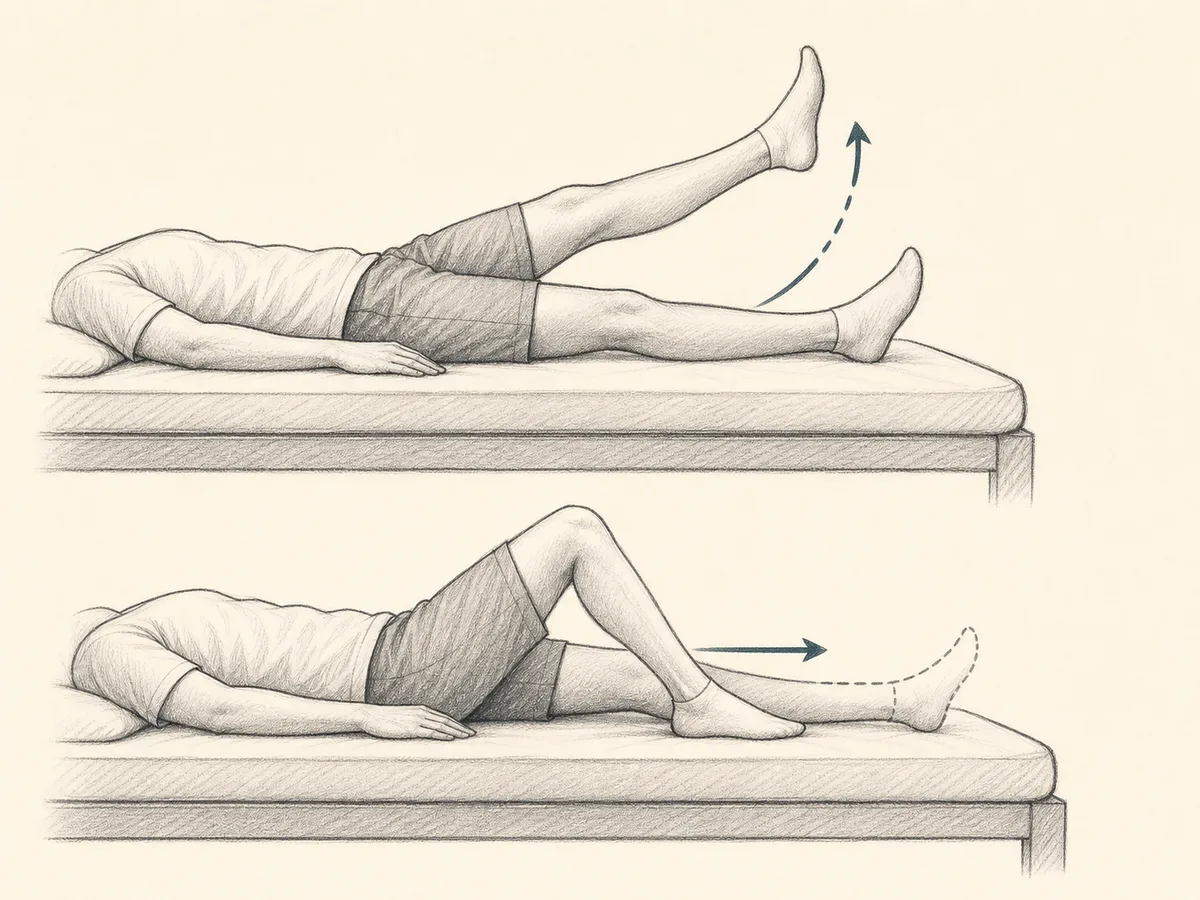
One rule sits above all of these: progress under a physiotherapist, and never push into sharp pain. A gentle stretch is fine. A stab is a stop. The right load on the right day is what a trained physio adds that a printed sheet cannot.
Range of motion goals, what the numbers mean
Range of motion is measured in degrees of bend, from a fully straight knee at 0°. Two numbers matter: how far you can bend (flexion) and how straight you can go (extension).
You need about 90° to sit and stand comfortably, 110 to 120° for stairs and cycling, and 0° of full extension to walk without a limp. Most patients reach about 80° by week 2 and 100° by week 7 (Yale Medicine, Healthline). Full extension is just as important as bend, because a knee that will not straighten changes how you walk and tires the whole leg.
How long does PT last, and how many sessions?
Most structured physiotherapy runs 6 to 10 weeks, 2 to 3 times a week, for roughly 12 to 18 sessions (PMC). That said, the number of sessions is the smaller lever.
The bigger lever is the home programme you do between visits, 2 to 3 times every day. A patient who does their daily exercises and sees a physio twice a week beats a patient who relies on sessions alone. Consistency, not intensity, wins this one.
When you are choosing where to do that work, consider how hard it is to drive to a clinic on a walker, in Dubai heat, twice a week, for two months. That logistics problem is exactly what in-home rehab solves.
Managing pain and swelling during rehab
Some pain and swelling are part of healing for the first several weeks. The tools are simple: ice, elevation, and pacing.
Ice for 20 minutes on and 20 off, elevate the leg above the heart when resting, and pace your activity so you are not flaring the knee. Think of it as a "happy knee" budget: spend it on exercise and walking, not on standing in a kitchen for an hour. If you are still using narcotic painkillers, you cannot drive, and that affects your whole week. For persistent pain or recurring flare-ups, a structured plan from a physiotherapist experienced in sports and pain management helps you push the knee without overloading it.
Warning signs, when to call your surgeon
Most recoveries are uneventful, but a few signs need a prompt call. Do not wait these out.
- Signs of infection: fever, spreading redness around the wound, increasing warmth, or discharge (Mayo Clinic).
- Signs of a blood clot (DVT): calf pain, swelling, tenderness, or warmth, especially in one leg.
- Stiffness that stalls: if the knee will not reach about 90° by six weeks, it can signal arthrofibrosis, scar tissue that may need extra treatment.
BestDOC is not an emergency service. For a medical emergency in the UAE, call 998. For wound concerns or a clinical question during recovery, our coordinators can route a clinician to your home.
Doing your knee-replacement rehab at home in Dubai
Here is the part the US hospital guides leave out: you do not have to leave home to recover well. A DPT, MSc Speech Therapy, German-certified Lymphedema Physiotherapist, DHA & MOH licensed can run your entire programme in your living room.
For someone three weeks out of surgery, that difference is real. No arranging a driver, no walker in a car park, no waiting room. The physio brings the work to you, watches how your knee actually moves at home, and adjusts the plan on the spot. BestDOC home physiotherapy starts from AED 300 for a 60-minute session, delivered by a physiotherapist licensed by the Dubai Health Authority.
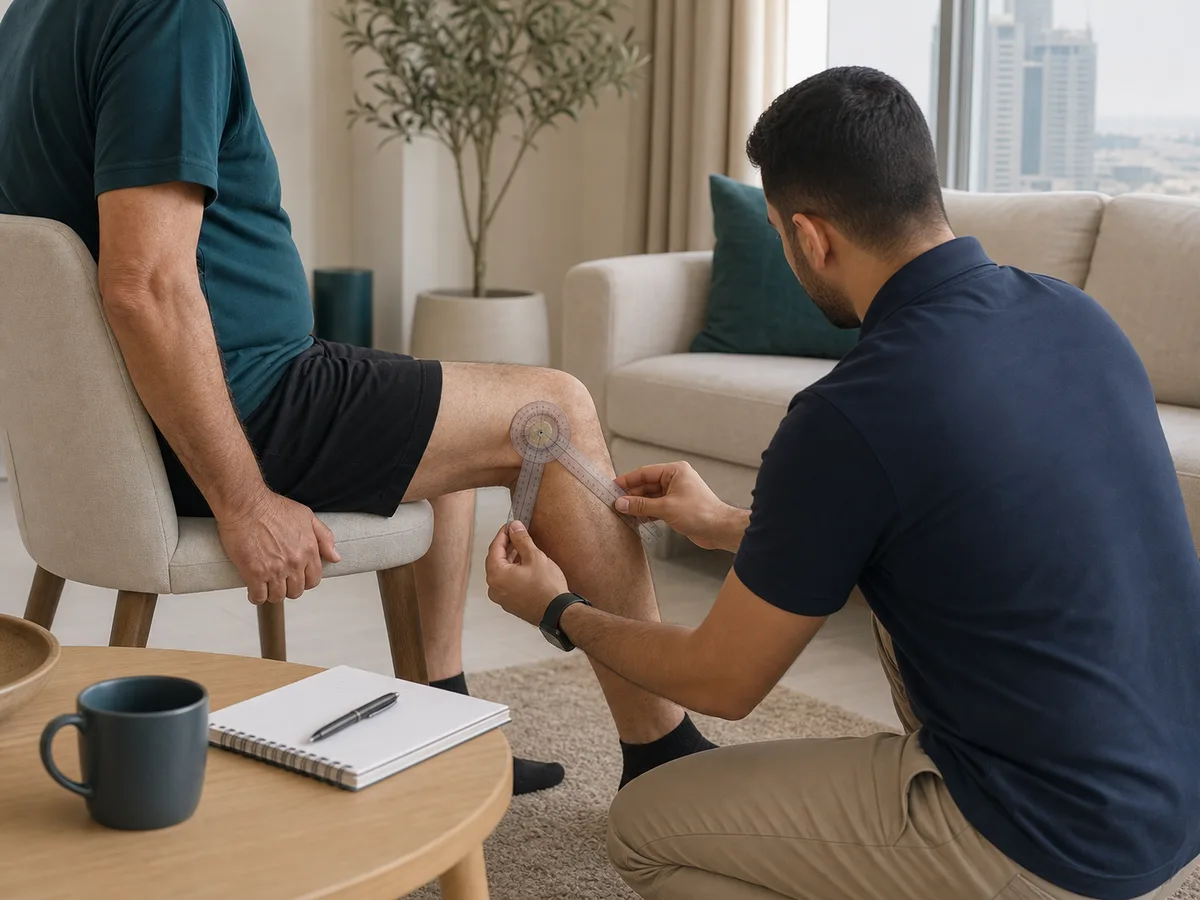
The brand difference is continuity. A knee rehab runs 6 to 12 weeks, and BestDOC keeps the same physiotherapist on your case the whole way. They know your knee's history, your last session's numbers, and where you stalled. For a longer recovery, staged post-surgical rehab is coordinated directly with your surgeon, with the plan signed off and quoted on request. Every clinician is vetted by our DHA-licensed team.
When Aisha's mother came home after a total knee replacement in Mirdif, she dreaded the clinic trips most. Instead, the same BestDOC physiotherapist visited three times a week. By week six her mother was bending past 110°, off the cane, and managing the stairs to her own bedroom again, without setting foot in a car.
Returning to driving, work and daily life
Timelines vary, but the general windows are steady. Driving usually returns at 4 to 6 weeks, once you are off narcotic painkillers and your surgeon clears you. Desk work is often possible at 4 to 6 weeks. Physically demanding jobs can take up to 3 months (Healthline).
Walking aids follow the same arc: a walker for about 2 to 3 weeks, then a cane, then unaided by around week three for many people. Let your knee, not the calendar, make the final call.
Conclusion
Recovery after a total knee replacement is earned in the weeks after surgery, not the operating room. Start therapy within 24 hours, chase your range-of-motion targets, do the home exercises 2 to 3 times a day, and watch for the warning signs. Most people are back to about 75% by month three and most of normal life within the year.
If driving to a clinic on a walker is the obstacle, bring the rehab home. Book home physiotherapy in Dubai with the same physiotherapist every visit, or talk to our team about a plan coordinated with your surgeon. Toll-free +971 800 2378 362 or WhatsApp, 24/7, across all of Dubai.
Educational. Not medical advice. Consult a licensed clinician about your own recovery.