


Peptide Blood Test Panel in Dubai: Which Labs to Run
If you bought a peptide labeled "research use only," the person who sold it to you is the wrong person to tell you your labs are fine. A peptide blood test panel in Dubai should cover a core set (CBC, liver, kidney, fasting glucose, HbA1c, lipids) plus add-ons matched to what you're taking, read by a doctor with nothing to sell you. Here's exactly what to ask for.
Key Takeaways
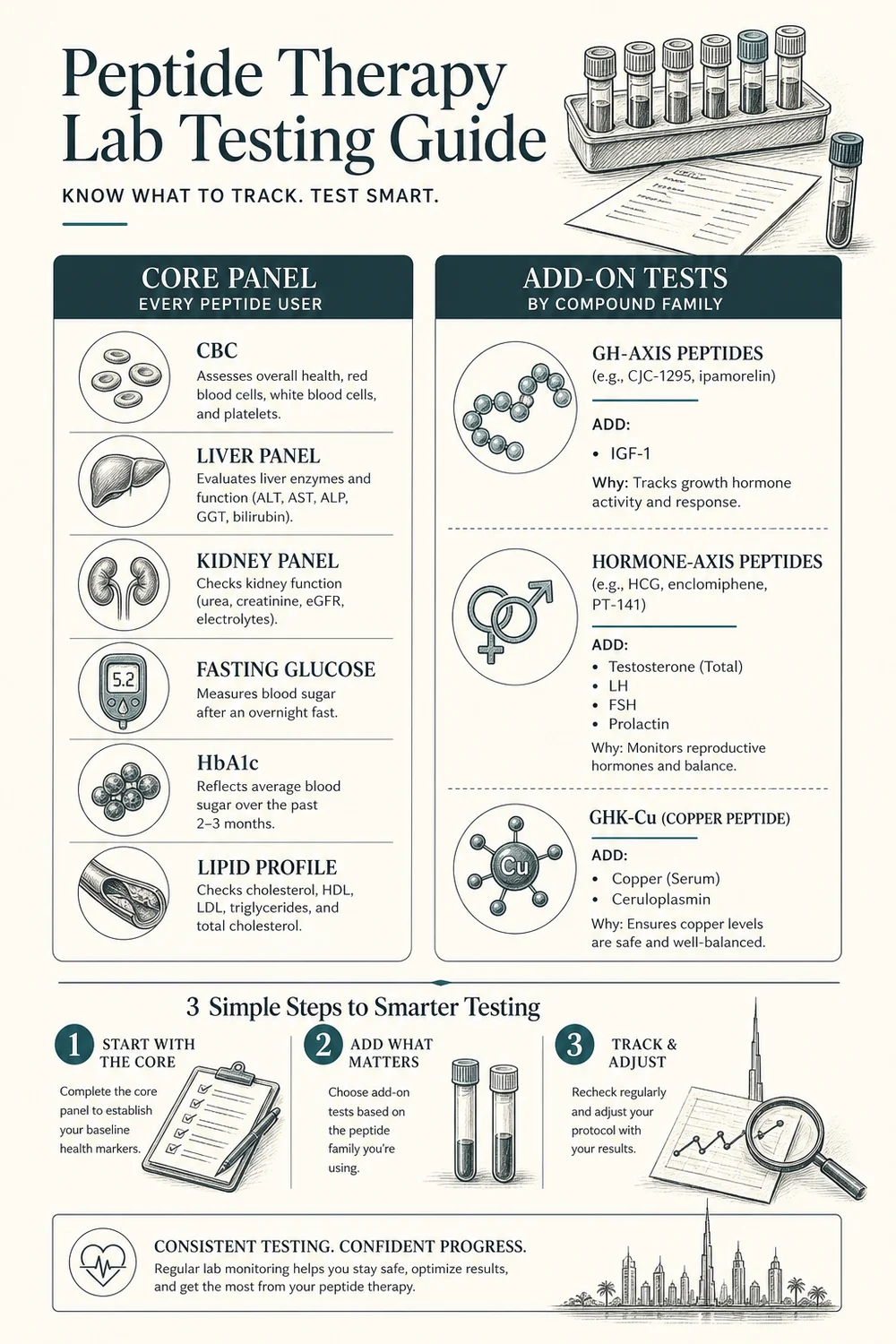
- Every peptide user needs the same core panel first: CBC, liver function, kidney function, fasting glucose, HbA1c and a lipid profile.
- GH-axis compounds (CJC-1295, Ipamorelin, tesamorelin, retatrutide, tirzepatide grey-market) need IGF-1 added on top.
- Kisspeptin and PT-141 users need testosterone, LH, FSH and prolactin, since both act on the reproductive hormone axis.
- GHK-Cu injectors need serum copper and ceruloplasmin, not just topical users.
- The person interpreting your results shouldn't be the person who sold you the compound. BestDOC doesn't sell peptides, so it has nothing riding on your numbers.
Why every peptide user needs a baseline panel first
Peptides bought without a prescription come with no monitoring built in. Nobody is scheduling your follow-up, checking your labs, or telling you what "normal" looks like for your body specifically. A baseline panel, run before you start or as early as possible if you're already using one, is the only way to know your own starting point before a symptom forces the question.
Take retatrutide: it's still in Phase 3 trials and approved nowhere in the world, which means every dose in circulation is grey-market by definition and the safety database is still being written (ClinicalTrials.gov, NCT05929066). A reader using it without any lab tracking is running a one-person trial with no data collection. A baseline panel is the cheapest way to start collecting it.
The core panel everyone should run
Regardless of which peptide you're using, this is the panel that catches organ and metabolic changes across the board, including the liver strain that shows up first on enzyme markers before symptoms do (NIH: Liver Function Tests). Run it once as a baseline, then again if anything about how you feel changes.
| Test | What it screens for | Fasting | Price |
|---|---|---|---|
| Complete Blood Count | Anemia, infection, immune changes | No | AED 40 |
| Liver Function Test | Liver strain from injectable compounds | Optional | AED 60 |
| Kidney Function Test | Filtration load, dehydration effects | Optional | AED 60 |
| Fasting Glucose | Blood sugar shifts, common with GLP-1/GH-axis use | Yes | AED 25 |
| HbA1c | 3-month glucose average | No | AED 60 |
| Lipid Profile | Cholesterol and triglyceride changes | Yes | AED 90 |
Each of these is drawn from a single visit through BestDOC's home lab tests, and priced as an individual test rather than bundled, so you only pay for what your peptide actually calls for. Want to see the full list of tests BestDOC draws at home? Browse the health screening panels →
Add-on tests by compound category
The core panel is the floor, not the ceiling. Which add-ons matter depends entirely on which axis your compound is working on. IGF-1 tracks growth hormone activity because it stays stable through the day, unlike GH itself (MedlinePlus: Growth Hormone Tests).
| Compound family | Add-on tests | Why |
|---|---|---|
| GH-axis: CJC-1295, Ipamorelin, tesamorelin, sermorelin, retatrutide, grey-market tirzepatide | IGF-1 | These raise growth hormone and IGF-1 directly; sustained elevation is the long-term signal worth tracking |
| Hormone-axis: kisspeptin, PT-141 | Testosterone (total + free), LH, FSH, prolactin | Both act on the reproductive hormone axis; you can't tell if it's moving without a starting point |
| GHK-Cu injectors | Serum copper, ceruloplasmin | Injectable copper peptide has essentially no long-term human safety data; copper studies catch what topical use never touches |
For anyone stacking CJC-1295 and Ipamorelin specifically, IGF-1 is the single most useful number in this whole article. Formal clinical development of CJC-1295 was halted in 2006 after a participant death in a Phase II trial for HIV-related visceral obesity (ClinicalTrials.gov, NCT00267527), stated once, plainly, because it's the reason IGF-1 tracking on GH-axis stacks isn't optional. The physiology behind why IGF-1 moves the way it does is worth watching in full if you want the mechanism, not just the number.
Ready to test the difference between guessing and knowing? Talk to a BestDOC doctor about your case →
Independent monitoring vs. bundled seller "checkups"
Some longevity clinics sell peptides and offer "monitoring" as part of the same package. That's a conflict of interest stated plainly: whoever reads your labs shouldn't be whoever sold you the vial. If your results look concerning, the person with a bundle to protect has an incentive problem the person with nothing to sell doesn't.
Yusuf, a Dubai-based reader on a GH-secretagogue stack for eight months, had never had his IGF-1 checked before. He'd been told by the seller that "everyone's numbers look fine at this stage." His baseline panel, run independently, came back with IGF-1 above the reference range, something that conversation would never have surfaced on its own. He didn't stop using the compound that day. He booked a doctor's review, which is the entire point of testing independently.
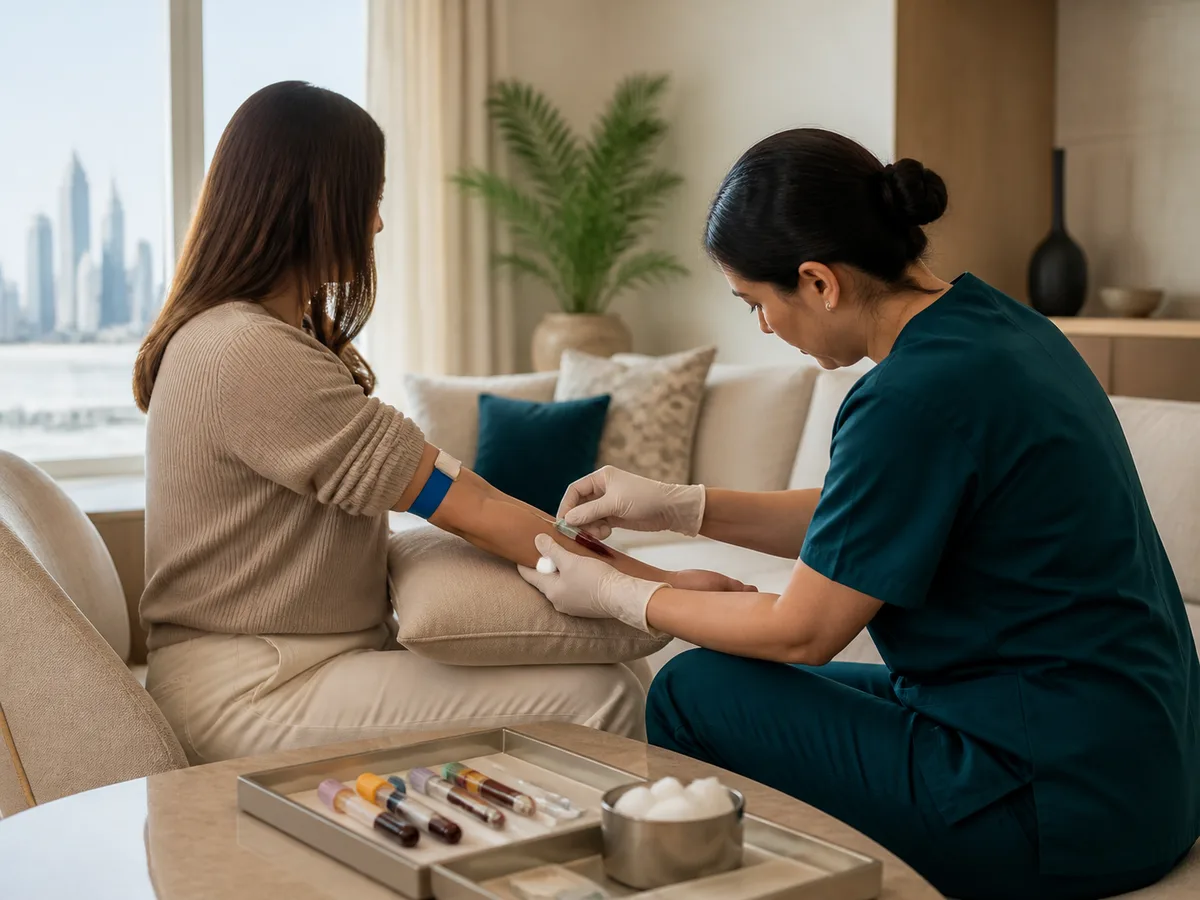
BestDOC does not sell, supply, endorse or recommend any peptide. The panel and the doctor reading it have nothing riding on your result either way.
How BestDOC's peptide panel works
A DHA-licensed nurse draws the tests at home; a BestDOC doctor, not the peptide seller, reads the report back to you. Results come back on their own schedule rather than all at once: the core panel and most add-ons (CBC, LFT, KFT, glucose, HbA1c, lipids, testosterone, LH, FSH, prolactin, copper) are ready within 8 hours, while IGF-1 and ceruloplasmin take up to 7 days. We send whichever results are ready first, and the rest follow.
There's no bundled "Peptide Baseline Panel" SKU yet, each test above is priced and booked individually, and a coordinator will build the exact list you need into a single home visit, starting from a CBC + liver + kidney bundle with your specific add-ons folded in over WhatsApp or a call to +971 800 2378 362, available 24/7 across Dubai.
How often to repeat testing
Baseline before you start, or as soon as possible if you're already using one. For ongoing GH-axis users, rechecking IGF-1 alongside fasting glucose roughly every three months is a reasonable cadence while you're actively using the compound; that interval sits between how the Endocrine Society recommends monitoring GH therapy during dose changes and once treatment is stable (Endocrine Society Clinical Practice Guideline). Once your numbers hold steady across two or three checks, spacing out to twice a year is reasonable, in conversation with the doctor reading your results.
Frequently asked questions
What blood tests should I get before starting a peptide? A core panel: complete blood count, liver function, kidney function, fasting glucose, HbA1c and a lipid profile.
Do I need to test IGF-1 if I'm using CJC-1295 or Ipamorelin? Yes. Both raise growth hormone and IGF-1, and sustained elevation is the long-term signal worth tracking (NIH: IGF-1 monitoring in medical diagnostics).
What tests should I run if I'm using kisspeptin or PT-141? Total and free testosterone, LH, FSH and prolactin, the axis both compounds act on (NCBI: The Hypothalamic-Pituitary-Gonadal Axis).
Why not just use the labs my peptide supplier offers? The person interpreting your results shouldn't be the person who sold you the vial. BestDOC doesn't sell peptides.
How much does a peptide blood panel cost at BestDOC? Each test is priced individually; a CBC is AED 40 and IGF-1 is AED 130.
How often should I repeat the panel? Baseline first, then roughly quarterly for IGF-1 and metabolic tracking while you're actively using a GH-axis compound.
Does BestDOC sell or prescribe peptides? No. BestDOC does not supply, endorse or recommend any peptide.
What happens if a result comes back abnormal? The doctor reading your panel flags it and talks you through next steps, which may mean pausing the compound or seeing a specialist.
The cheapest insurance policy you'll buy this year
One panel, read independently, tells you more about your own risk than anything on a seller's page. Run the core panel first, add IGF-1 or hormone tests for what you're actually taking, and repeat it on a schedule instead of waiting for a symptom to force the question. Book your panel through BestDOC's home health screening → or talk to a doctor about your case before your next dose.
Most compounds discussed are not registered medicines in the UAE and are sold as research chemicals without pharmaceutical quality control. This article is educational and is not medical advice, a recommendation, or an endorsement. Best Doc does not prescribe or supply peptides. If you are using or considering any compound discussed here, a baseline blood panel and a doctor consultation are the minimum sensible safety layer. Best Doc provides both at home, independently, we have nothing to sell you but the checkup.