

PEP for HIV in Dubai: What to Do in the First 72 Hours After Exposure
If you may have been exposed to HIV in Dubai, the single most important fact is the clock: post-exposure prophylaxis (PEP) must start within 72 hours, and sooner is better. PEP is a prescription course of antiretroviral medicine that can substantially lower the risk of HIV taking hold after a possible exposure. It is not a cure, and it is not 100% protection, but in the right window it works.
You are probably reading this at an anxious moment, perhaps late at night. So here is the short version first: note the time of exposure, and go in person to a hospital emergency department now — in Dubai, a government hospital such as Rashid Hospital — where a doctor can assess the exposure and start PEP. The rest of this page explains where to go, what happens there, and the testing that follows, so a frightening situation has a clear set of steps instead of a guess.
Please read this first. BestDOC is a home healthcare service. We do not supply PEP, prescribe the antiretroviral medicine, or run the emergency exposure assessment. PEP is started at a hospital. If a possible exposure was in the last 72 hours, do not wait on a phone call — go to a government hospital emergency department, such as Rashid Hospital. Where we can help is the HIV testing around PEP: a confidential at-home HIV test for AED 99 for your baseline and follow-up.
Key Takeaways
- PEP can reduce the risk of HIV after a possible exposure, but it must begin within 72 hours, ideally within 24 (CDC).
- It is a prescription-only, 28-day daily course of antiretroviral medicine. It cannot be bought on your own.
- PEP is started at a hospital, not by a home-visit service or a pharmacy. In Dubai, go to a government hospital emergency department, such as Rashid Hospital, which has an infectious diseases service.
- PEP is for emergencies after a one-off exposure. PrEP is the ongoing option for repeated risk. They are not the same medicine or plan.
- A baseline HIV and STI test is taken at the start, with follow-up tests during and after the course. BestDOC can do these at home — book the HIV p24 antigen test at home for AED 99. This is the one part of the journey we handle, not the PEP itself.
What is PEP, and how soon do I need it?
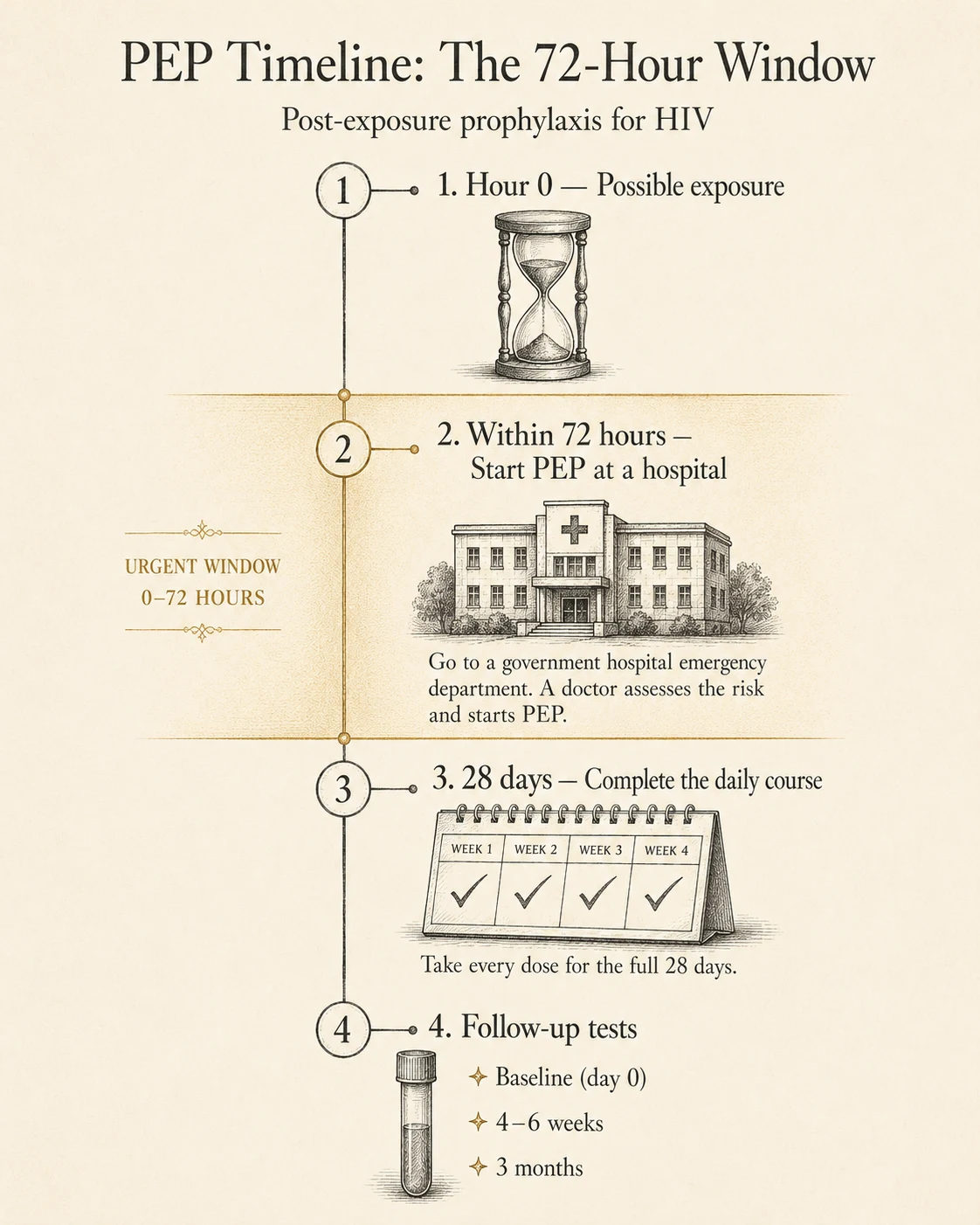
PEP, or post-exposure prophylaxis, is a short course of antiretroviral medicine taken after a possible HIV exposure to stop the virus from establishing infection. The window is strict: it must begin within 72 hours of exposure, and effectiveness drops the longer you wait, which is why every hour matters (CDC).
Think of PEP as putting out a spark before it becomes a fire. The medicine blocks the virus from copying itself in the days when an infection would otherwise establish. Once that early window closes, the medicine can no longer do that job.
A full course runs for 28 days, taken every day, usually as a combination of antiretroviral tablets (HIV.gov). The World Health Organization recommends PEP as part of HIV prevention precisely because of this narrow, time-bound window (WHO). It is prescription-only and is meant for occasional, emergency use after a single exposure, not as a routine method of prevention.
Common reasons people in Dubai look into PEP include a condom that broke or slipped, sex without protection with a partner of unknown status, a needlestick or sharps injury, or a possible exposure after assault. In every one of these, the clinical question is the same: how high was the risk, and is there still time to act?
What to do right now after a possible HIV exposure in Dubai
If the exposure was in the last 72 hours, here is the order of steps that matters most:
- Note the time of the exposure. The 72-hour window starts from that moment, not from when you start worrying about it.
- Go to a hospital emergency department now. In Dubai, a government hospital such as Rashid Hospital is the practical route — it has a 24-hour emergency department and an infectious diseases service. Tell them you may have had an HIV exposure within the last 72 hours and ask to be assessed for PEP.
- A hospital doctor grades the risk and, if PEP is appropriate and you are inside the window, starts it there. The assessment and the medicine both happen at the hospital.
- Get a baseline HIV and STI test at the start, before or as PEP begins, so your status at the time of exposure is documented.
- Take the full 28-day course and attend the follow-up tests. Finishing matters as much as starting.
One honest caveat: if there is serious injury, sexual assault, or a medical emergency, that is emergency territory — go to the nearest emergency department or call 998. Do not let a phone call or a web search eat into the 72-hour window. The fastest reliable path is to present in person at a hospital.
If a possible exposure was in the last 72 hours, the clock is what matters. Go to a government hospital emergency department, such as Rashid Hospital, today.
Where to get PEP in Dubai
PEP in the UAE is prescription-only, and it is started in a hospital — not at a pharmacy counter, and not through a home-visit doctor service. You cannot pick it up over the counter, and you should never buy antiretrovirals online or from informal sources. The medicine, the dose, and the decision to start all depend on a clinical assessment done at the hospital.
In Dubai, the practical place to go is the emergency department of a government hospital such as Rashid Hospital (Dubai Health), which runs an infectious diseases service. Go in person, explain that you may have had an HIV exposure within the last 72 hours, and ask to be assessed for PEP. Because it is time-critical, presenting at the emergency department is faster and more reliable than trying to arrange it by phone.
What BestDOC does and does not do here. We want to be completely clear, because this matters. BestDOC does not provide PEP, does not prescribe the antiretroviral medicine, and does not run the emergency exposure assessment. That care belongs in a hospital, and if you may have been exposed, that is where you should go now. The one part of this journey we can help with is the HIV testing — see the next section.
For the deeper detail on the testing itself, how each HIV test works and the window periods, see our guide to a home HIV test in the UAE.
How effective is PEP?
PEP substantially reduces the risk of HIV when it is started in time and the full course is completed, but it does not remove the risk entirely (CDC). Two things drive the outcome: how soon you start, and whether you take every dose for the full 28 days.
That honesty matters. Anyone promising absolute protection is misleading you. What the evidence supports is that early, complete PEP makes a real and meaningful difference, which is exactly why the timing and adherence are treated so seriously.
It also means PEP is not a substitute for prevention. After the course, the conversation often turns to longer-term options for anyone with ongoing risk, which is where PrEP enters the picture.
PEP vs PrEP: which one applies to you?
People often confuse the two. The simplest way to separate them: PEP is after, PrEP is before.
| PEP | PrEP | |
|---|---|---|
| When taken | After a possible exposure | Before and during periods of risk |
| Timing | Must start within 72 hours | Ongoing, taken in advance |
| Duration | 28-day course | Continuous, while risk continues |
| Best for | A one-off or unexpected exposure | Repeated or anticipated risk |
| Where to start | Hospital emergency department | Planned consult and baseline tests |
If you have had a single, unexpected exposure, PEP is the emergency response and the hospital is where it begins. If your situation involves repeated risk, a clinician may discuss PrEP as the longer-term plan once any current PEP course is complete (WHO). Both are clinical decisions, not something to source on your own.
The 28-day course: side effects, adherence, and follow-up
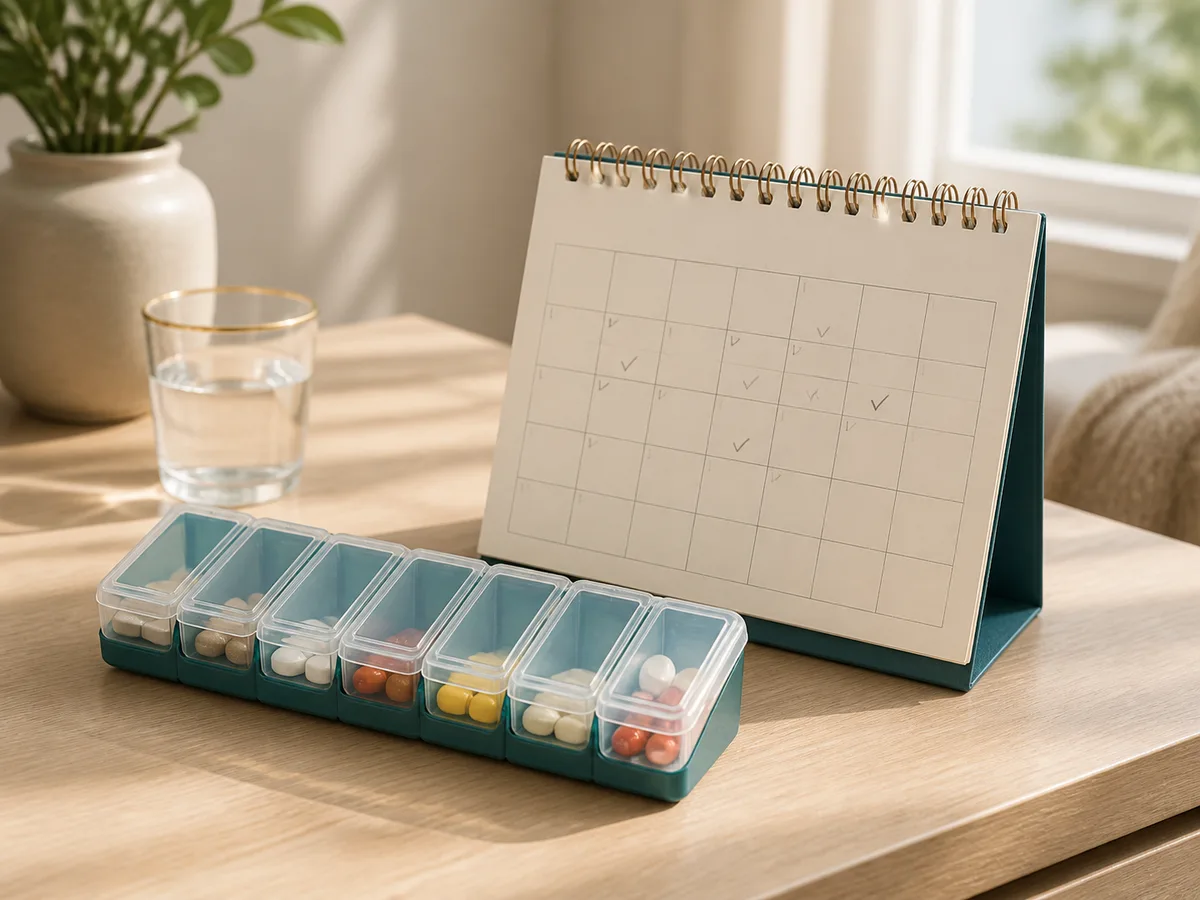
PEP is not one pill and done. It is a daily, four-week commitment, and that is the part most people underestimate. The medicine is generally well tolerated, but some people feel nausea, tiredness, headache, or stomach upset, especially in the first days (HIV.gov). These usually ease, and the hospital team that started your PEP can help manage them so you do not stop early.
Finishing the course is what protects you. Missed doses lower the chance that PEP does its job, so adherence over the full 28 days is the goal, not just a strong start.
Follow-up testing runs alongside the course: a baseline test at the start, then repeat HIV testing at intervals after exposure, commonly around 4 to 6 weeks and again at about 3 months, to confirm your status once the window periods have passed.
This is the one place home care fits, and it is worth being precise about it. The hospital starts and oversees your PEP. Separately, the repeat HIV and STI bloods can be drawn at home if you would rather not sit in a waiting room each time — a DHA-licensed home nurse can take them, and you see the same nurse across the weeks. It is a convenience around the testing, not a substitute for the hospital's care of the PEP course itself.
Testing and confidentiality
A baseline HIV and STI test sits at the start of the PEP timeline, with follow-up testing during and after the course. The point of the baseline is to document your status at the time of exposure; the follow-up tests confirm where you stand once the window periods close (CDC).
On confidentiality, here is the honest UAE position. Your consultation and results are handled as private health information under UAE health rules, shared only through a channel you choose. At the same time, a confirmed HIV-positive result is notifiable to UAE health authorities, so testing is confidential but not fully anonymous. Knowing that in advance is better than being surprised by it.
If you want the full picture on test types, accuracy, and window periods before you book, our home blood test guide covers it in depth, and you can read about our clinicians on the BestDOC team page.
HIV testing at home: the part BestDOC can help with
To be clear once more: PEP itself is started and overseen at a hospital. What BestDOC can take off your plate is the HIV testing around it — both the baseline test at the start and the follow-up tests weeks later.
A confidential at-home HIV p24 antigen test is AED 99. A DHA-licensed nurse comes to you, draws the sample, and the result is handled privately. For the follow-up tests across the weeks after exposure, the same arrangement applies, so you can complete the testing schedule without a clinic trip each time. The price is confirmed upfront, and BestDOC is available across Dubai, on the toll-free line +971 800 2378 362 or by WhatsApp.
This is the honest boundary of what we offer on this topic. For the emergency PEP assessment and the medicine, go to a government hospital such as Rashid Hospital. For the testing that sits before and after it, we can come to you. You can book through the doctor-on-call service or contact BestDOC directly.
If a possible exposure was in the last 72 hours, go to a hospital today. The window does not reopen.
Educational. Not medical advice. Consult a licensed clinician. PEP and PrEP are clinical decisions made by a licensed doctor after assessing your situation. For emergencies, call 998. Do not obtain antiretroviral medicine from informal or online sources.