


Parkinson's exercises at home: a caregiver's guide to balance, falls and freezing of gait
The most useful Parkinson's exercises at home target four things: balance, leg strength, upright posture, and big, deliberate movements, done most days with someone cueing each repetition. For a caregiver, the daily routine matters as much as any clinic visit.
You already sense that movement helps your parent. What you may not have is a clear, safe routine and the words to coach it. This guide gives you both: the exercises that hold up to evidence, the rescue cues for the moment your parent freezes mid-step, and the point at which a home physiotherapist should set and progress the plan.
Key Takeaways
- Daily movement is one of the few things shown to help maintain function and lower fall risk in Parkinson's.
- "Big" amplitude movements, the idea behind LSVT BIG, counter the small, shrinking motions of Parkinson's.
- Freezing of gait responds to cueing: counting, a beat, or stepping over a line on the floor.
- Most falls happen on turns and thresholds, so home setup matters as much as exercise.
- A home physiotherapist sets and progresses the plan; a trained caregiver runs it daily.
Why home exercise matters in Parkinson's
Exercise will not cure Parkinson's, but it is one of the few things that may help maintain mobility, balance and independence as the condition progresses. Parkinson's affects the body's control of smooth, automatic movement, so deliberate practice helps the brain and muscles hold on to patterns that would otherwise fade. The US National Institute of Neurological Disorders and Stroke lists regular physical activity among the supportive measures for the disease, and the World Health Organization notes that rehabilitation improves daily functioning.
The Parkinson's Foundation treats exercise as a core part of care, not an extra, and the US National Institute on Aging backs physical therapy and exercise to support movement and balance. The pattern that helps most is small and steady: short sessions on most days beat one long, exhausting block.
One caveat first. Clear any new routine with the treating neurologist or physiotherapist before you start, especially if your parent has had recent falls, dizziness, or heart concerns. Want a plan built around your parent specifically? Home physiotherapy in Dubai starts with a single assessment visit.
The "big movement" principle
Parkinson's shrinks movement. Steps get shorter, handwriting gets smaller, arm swing fades, and the person often does not notice it happening. Amplitude training works against that drift by drilling movements that feel exaggerated but actually land close to normal size.
This is the idea behind LSVT BIG, a certified protocol delivered over four weeks, four days a week, in hour-long sessions, that retrains the brain's sense of how big a movement should be. A review of LSVT BIG research describes this recalibration of movement size as its central mechanism, and LSVT Global sets the training standard. LSVT BIG itself is a trademarked programme delivered by certified clinicians, so think of the home drills below as the same principle, moving bigger on purpose, rather than the formal course.
The coaching cue is simple, and you will repeat it often: "Big." Big step. Big reach. Big swing. Your job as caregiver is to be the external reminder the disease takes away.

Daily Parkinson's exercises you can do at home
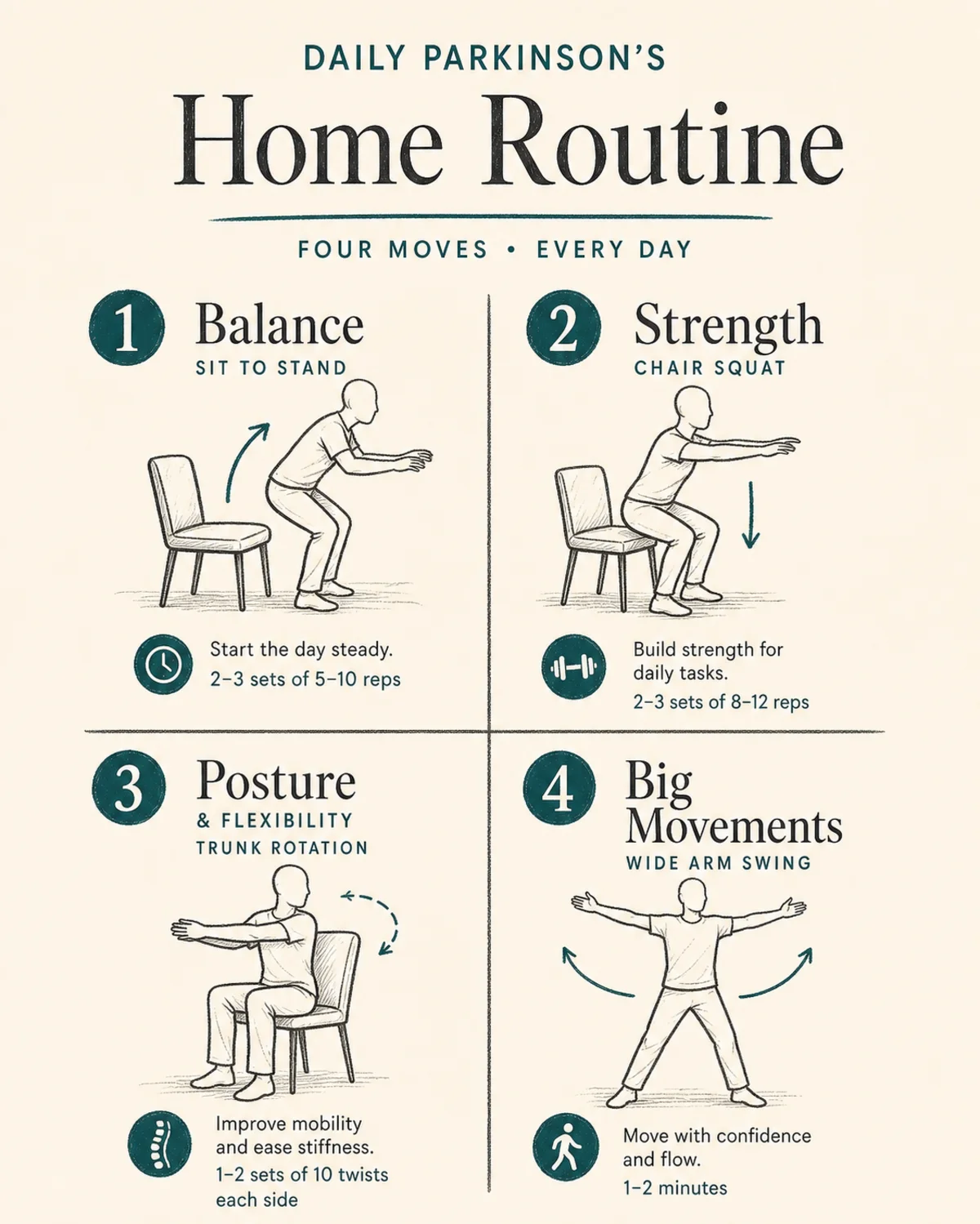
Build the day of Parkinson's exercises at home around four blocks: balance, strength, posture and big movements. None of this needs equipment beyond a sturdy chair and a clear wall. Supervise every session, and stop if your parent is short of breath, dizzy or in pain.
Balance. Balance exercises for Parkinson's are the priority: sit-to-stands from a firm chair, slow weight shifts from foot to foot, and heel-to-toe walking along a line on the floor. Stand close, ready to steady, never pulling.
Strength. Chair squats, step-ups onto a low secure step, and calf raises at the kitchen counter. Lower-limb strength is what gets a person off a chair and away from a fall.
Posture and flexibility. Seated trunk rotation, reaching both arms overhead, and gentle chin tucks to counter the forward stoop Parkinson's encourages.
Big movements. Marching with high knees and wide arm swings, big sideways steps, and large reaching motions, all done with that "big" cue out loud.
| Exercise | What it targets | Caregiver cue | Reps |
|---|---|---|---|
| Sit-to-stand | Leg strength, balance | "Nose over toes, push up big" | 8–10 |
| Heel-to-toe walk | Walking balance | "Eyes up, long line" | 10 steps |
| Chair squat | Quads, glutes | "Slow down, big stand" | 8–10 |
| Step-up | Stair confidence | "Whole foot on, drive up" | 6 each leg |
| Trunk rotation (seated) | Posture, mobility | "Turn and reach behind" | 6 each side |
| Marching + arm swing | Gait, amplitude | "Big knees, big arms" | 20 steps |
When Layla's father in Dubai Marina first tried morning sit-to-stands in March, he managed four before tiring and gripped the armrest the whole way. She kept the routine short, cued "push up big" each time, and ran it daily before breakfast. By May he was doing ten clean stands and rising from the sofa without a hand, the kind of gain that keeps someone independent.
Managing freezing of gait
Freezing of gait is a sudden, brief inability to move the feet forward, as if they are stuck to the floor, most often at doorways, turns, or when starting to walk. It is frightening and a major cause of falls, but it responds well to cueing. A systematic review in the PMC archive found that cueing and structured exercise reduce freezing severity.
Keep these rescue cues memorised. In the moment of a freeze, calmly use one:
- Count out loud: "one, two, three, step."
- Step to a beat: hum a march or use a metronome app.
- Step over a line: point to a tile edge or place your foot for them to step over.
- Shift weight side to side before trying to step forward.
- Look ahead, not at the feet: a target across the room pulls the body forward.
Never pull a frozen person forward; it raises fall risk. Stand beside them, give one clear cue, and wait.
Fall prevention at home
Most Parkinson's falls happen in three situations: turning, crossing a threshold, and doing two things at once, like walking while talking. Reduced balance and leg strength make these moments risky, which is why the exercises above and the home itself both matter. A fall-prevention exercise trial in Parkinson's tests balance and strength training as a way to lower fall rates, and Parkinson's UK covers the same home-safety ground.
Dubai homes carry their own hazards. Polished marble and tile are slick, especially near an AC unit's drip mat, and loose rugs slide.
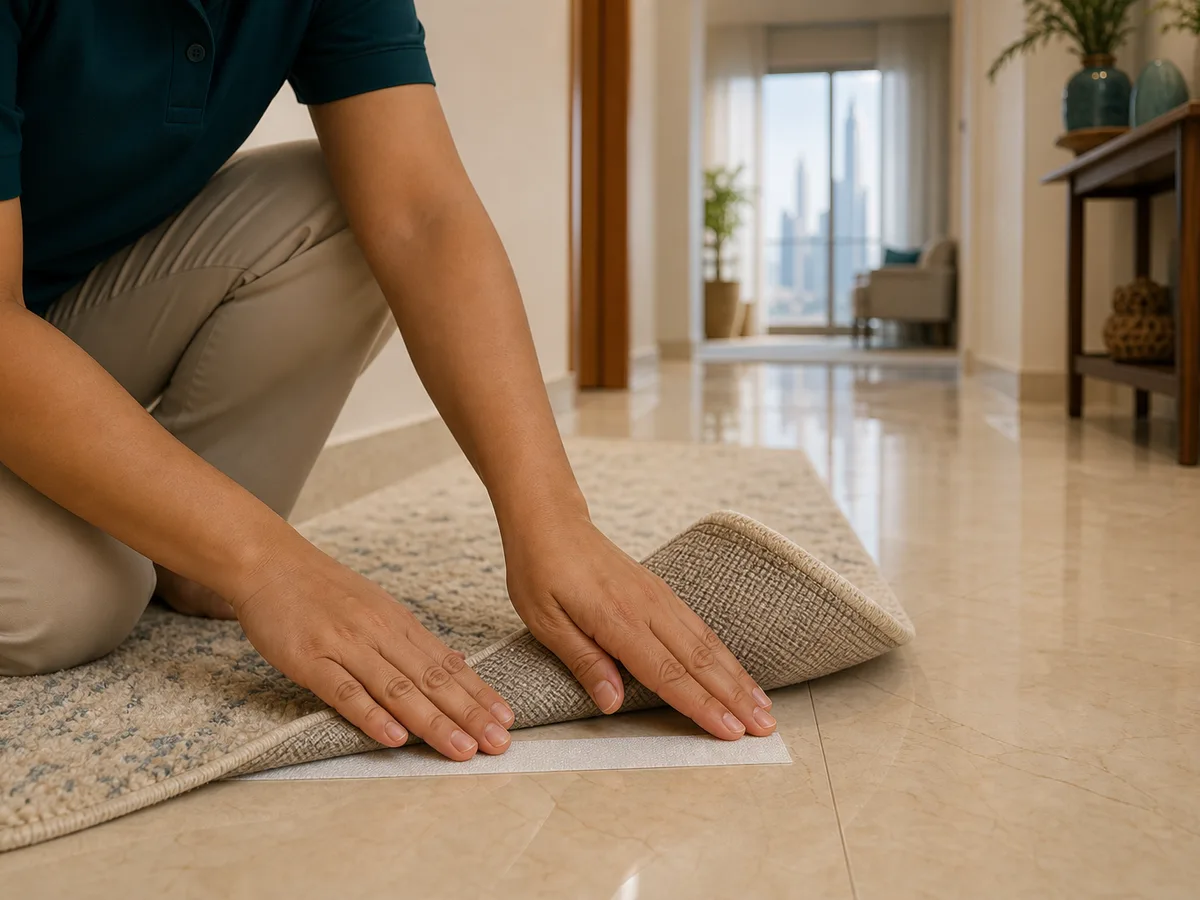
Walk through the home and fix the basics: secure or remove rugs, clear walking paths, add grab rails by the bed and in the bathroom, light the route to the toilet at night, and switch slippers for firm, closed shoes with grip. Practise turns as wide, slow arcs rather than tight pivots.
Ready to make the home safer and the routine stick? A home assessment turns this checklist into a plan tailored to your parent. Talk to a clinician about your case.
When to bring in a home physiotherapist
Self-directed exercise carries a person only so far. A DPT, MSc Speech Therapy, German-certified Lymphedema Physiotherapist, DHA & MOH licensed adds what a caregiver cannot: a proper assessment, a graded plan matched to the stage of disease, safe progression as strength returns, and an expert eye on technique and over-exertion. That is the difference between movement and rehabilitation.
BestDOC home physiotherapy in Dubai starts from AED 350 for a 60-minute session with a DPT, MSc Speech Therapy, German-certified Lymphedema Physiotherapist, DHA & MOH licensed, and the same physiotherapist returns each visit so the plan builds rather than restarts. Where a parent needs daily help running the routine, elderly care at home places a trained caregiver who carries the exercises between physio visits, with weekly reports to the family. If medication timing is shaping your parent's "on" and "off" windows for movement, you can request a doctor home visit (from AED 350) to review it.
This is the BestDOC model: our physiotherapist sets the plan, the same caregiver runs it day to day, and a DHA-licensed home nurse steps in for any clinical support. One household file, one team, our DHA-licensed clinicians reviewing the case. To book or ask a question, call toll-free +971 800 2378 362 or message us on WhatsApp, 24/7, anywhere in Dubai. (This is the practical companion to our home physiotherapy service.)
FAQ
What exercises are best for Parkinson's at home? A daily mix of balance work, lower-limb strength, posture and trunk rotation, and large amplitude movements. Clear the plan with the treating neurologist or physiotherapist first.
What is freezing of gait and how do you stop it? A sudden, brief inability to step forward, often at doorways or turns. It responds to cueing: count out loud, step to a beat, step over a line, or shift weight side to side.
Can exercise cure Parkinson's? No. Parkinson's has no cure. Regular movement may help maintain mobility and balance and may lower fall risk, so it is core to managing the condition alongside medical care.
Is it safe to do these without a physiotherapist? Gentle work is generally safe with supervision, but fall risk is higher in Parkinson's. An assessment sets a safe, graded plan a caregiver can then run daily.
How often should someone with Parkinson's exercise? Aim for some movement on most days of the week, split into shorter sessions if needed. A home physiotherapist sets the right volume and progression for the individual.
How much does home physiotherapy cost in Dubai? BestDOC home physiotherapy starts from AED 350 for a 60-minute session with a DPT, MSc Speech Therapy, German-certified Lymphedema Physiotherapist, DHA & MOH licensed, with the same physiotherapist returning for continuity.
Educational only. Not medical advice. Always consult a licensed clinician before starting or changing an exercise routine for a person with Parkinson's.
Start here: book a home physiotherapy assessment in Dubai, then contact our team to set the plan in motion.