


Can GLP-1 Help With Addiction? What Evidence Shows
Early research links GLP-1 receptor agonists, the same drug class as semaglutide and tirzepatide, to reduced cravings for alcohol and possibly other substances. But no GLP-1 drug is approved to treat addiction, and human evidence is still thin. Here's what the studies say, and why the right first move is a doctor visit, not a prescription request.
GLP-1's jump from diabetes and weight loss into the addiction conversation caught researchers off guard. Patients started telling their doctors, unprompted, that their drinking or smoking dropped after starting the medication. Researchers noticed the pattern too.
Key Takeaways
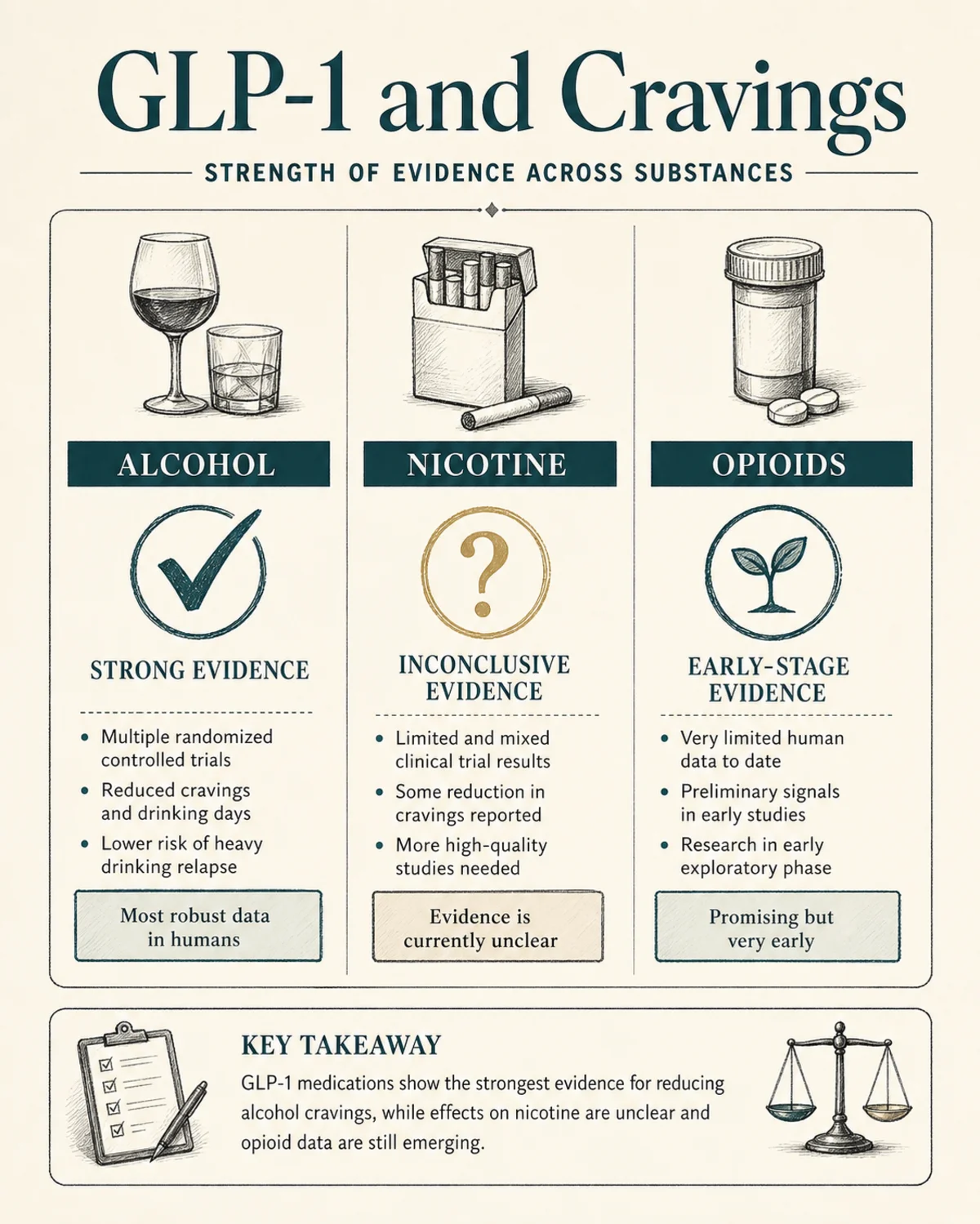
- Alcohol has the strongest evidence: several large retrospective studies link semaglutide and liraglutide use to fewer alcohol-related hospitalizations.
- Nicotine and opioid evidence is early and mostly from animal studies, not human trials.
- No GLP-1 drug is FDA-approved or DHA-approved for substance use disorder as of 2026.
- GLP-1 receptors sit in brain reward regions, which is the leading theory for why cravings might drop.
- BestDOC's doctor-led Weight Loss Programme already screens for alcohol and substance history at intake, and can prescribe GLP-1 for weight and metabolic reasons under medical supervision.
What GLP-1 is, and why it might affect cravings
GLP-1 receptor agonists are a drug class, not a single brand. Semaglutide and tirzepatide are the two most prescribed versions, developed for type 2 diabetes and now widely used for weight management, per Mayo Clinic's overview. They work by slowing digestion and signaling fullness to the brain.
That brain signaling is the part that matters here. GLP-1 receptors aren't limited to the gut, they also sit in the mesolimbic dopamine system, the brain's reward circuit, in regions like the ventral tegmental area and nucleus accumbens tied to addictive behavior. That overlap is what sent researchers looking at cravings.
Animal studies back this up more than human studies do. Preclinical work shows GLP-1 receptor agonists reduce self-administration of alcohol and nicotine in rodents, and some models show reduced cocaine and opioid-seeking behavior. These are mechanism studies: they explain a plausible pathway, not proof the drug works this way in people at prescribed doses. For a plain-language walkthrough, the American Psychiatric Association's APA TV segment on GLP-1 agonists and substance use disorders covers how the same pathway tied to appetite also touches reward and craving circuits.
Curious what a doctor-supervised GLP-1 plan actually involves? Explore BestDOC's Weight Loss Programme →
What the human evidence shows so far
Alcohol has the strongest signal. A large US retrospective cohort study, published via PubMed, found patients prescribed semaglutide or tirzepatide had lower documented rates of alcohol use disorder than those on other diabetes medications. Separate national registry studies out of Scandinavia found similar links between semaglutide or liraglutide prescriptions and fewer alcohol-related hospitalizations. A small randomized trial in Denmark, in heavy-drinking adults, reported fewer heavy-drinking days on semaglutide, flagged by researchers as early-stage.

Nicotine and opioids are thinner. Some observational data suggests a link, but no large human trial confirms it. The National Institute on Drug Abuse funds active research into GLP-1 for substance use disorders while stating plainly that no GLP-1 drug carries an approved indication for this use. The World Health Organization likewise treats GLP-1's addiction-related use as investigational.
What's still missing: no completed large-scale randomized controlled trial has confirmed GLP-1 as an addiction treatment for any substance. Everything published so far is retrospective, observational, or small-sample, a gap the NIH's research overview draws too.
When Fatima, a 41-year-old office manager in Dubai, mentioned to her doctor that her evening wine habit had quietly dropped since starting semaglutide for her weight programme, her doctor logged it as an observation, not a reason to change her care plan. Six months in, her labs and weight goals were on track. The craving change stayed a side note, watched but never treated as a cure.
Important cautions before using GLP-1 for addiction or cravings
GLP-1 is not a substitute for addiction treatment. If cravings or dependence are severe, that calls for an addiction-medicine specialist or psychiatrist, not an off-label weight-loss prescription.
Cautions to know before any conversation about starting GLP-1:
- Side effects: nausea, vomiting, and other GI effects are common early in dosing, per Mayo Clinic's semaglutide side-effect guidance.
- Contraindications: the FDA prescribing label rules out GLP-1 for anyone with a personal or family history of medullary thyroid carcinoma or MEN 2.
- No self-directed off-label use: dosing changes made for a craving effect, without medical supervision, carry real risk.
- Drug interactions: combining GLP-1 with addiction medications needs a doctor's review, not guesswork.
If you're already considering GLP-1, here's the right first step
Whether the reason is weight, metabolic health, or curiosity about the craving research, the first step is the same: a doctor-led intake that checks medical history, screens for contraindications, and builds a signed plan before any prescription is written.
BestDOC's Doctor at Home consultation and 12-week Weight Loss Programme are built around that. Intake includes a standard alcohol and substance use history. Where GLP-1 is prescribed through the programme, dosing is either nurse-administered at home or self-injected after a doctor visit, whichever fits the patient. A standalone GP visit to discuss GLP-1, outside the full programme, is billed at AED 300.
One line worth being direct about: BestDOC does not diagnose or treat substance use disorder. If craving or dependence is the primary concern, see a licensed addiction-medicine specialist or psychiatrist first. BestDOC's role is the doctor-supervised, weight-and-metabolic side of GLP-1, done safely and with the same clinician following up.
Ready to talk to a doctor about your options? Book a doctor consultation or contact BestDOC toll-free at +971 800 2378 362 / WhatsApp, 24/7, across Dubai.
Conclusion
The evidence connecting GLP-1 drugs to reduced cravings, alcohol especially, is real but early. Animal studies point to a plausible brain-reward mechanism; human data is mostly observational, and no GLP-1 drug is approved for addiction treatment anywhere. Curious about GLP-1 for any reason? Start with a doctor visit that screens your full history. BestDOC's team can walk you through what a doctor-supervised plan looks like, and what it doesn't treat.
Educational. Not medical advice. Consult a licensed clinician.