


Dementia Care at Home in Dubai: What Families Need to Know
Dementia care at home in Dubai means a trained caregiver, and a nurse where medical tasks are involved, supporting daily routines, memory and safety in the person's own home rather than a facility. Most families reach this point after noticing a change they can no longer manage alone.
Maybe it's a parent who repeats the same question three times in an hour. Maybe it's the stove left on, again. Whatever the trigger, the real question isn't whether to get help. It's what kind, and how much.
Key Takeaways
- Dementia home care covers two layers: daily/behavioral support from a caregiver, and medical tasks from a DHA-licensed nurse when needed.
- Wandering, missed medication, repeated near-falls and caregiver exhaustion are the clearest signs it's time to arrange outside help.
- BestDOC currently offers live-out dementia care only, daily, weekly or monthly, with pricing quoted per case.
- A gender-matched caregiver can be requested for dementia cases, same as general family care.
- If nursing care is requested alongside caregiving, both come in one booking; caregiver-only bookings keep nursing separate.
What Dementia Care at Home in Dubai Includes
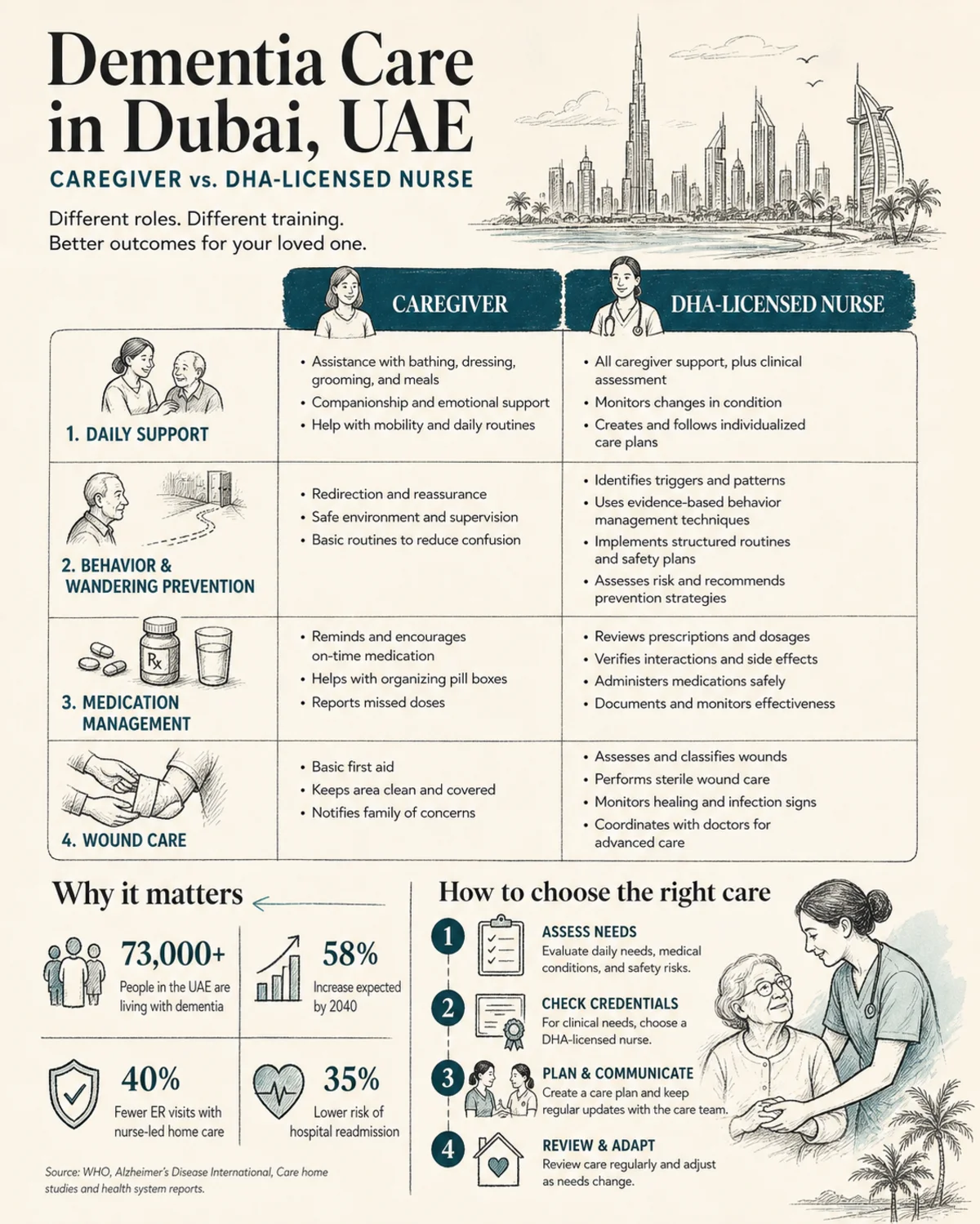
Dementia home care has two layers, and confusing them is where most families waste time. The first layer is daily support: bathing, dressing, meals, mobility and keeping a routine, since routine itself reduces confusion and agitation.
The second layer is cognitive and behavioral support. That means memory cues around the house, calm redirection instead of correction when someone repeats a question, and steps to prevent wandering, a locked door, a visible clock and calendar, a caregiver who never leaves the person alone near an exit.
Non-pharmacological support like this, alongside routine and social engagement, is specifically what the World Health Organization recommends can improve quality of life for people living with dementia, since there is no cure for the condition itself.
Wondering where your parent's needs fit? BestDOC's elderly care team builds the daily and behavioral side of the plan around what the household actually needs, not a fixed package.
Signs It May Be Time to Arrange Home Care
Two categories of signs tend to show up before a family reaches out. Safety signs come first: wandering outside, leaving an appliance on, repeated near-falls, or getting lost on a familiar route.
The second category is easy to miss because it isn't about the patient at all. It's caregiver burnout: a family member skipping their own meals, missing a parent's medication dose because they're stretched too thin, or simply looking exhausted every time you see them. The National Institute on Aging notes that depth perception changes with dementia make a change in flooring, tile to carpet, look like a step, which is part of why falls climb even in a familiar home.
When Layla started driving to her mother's apartment three times a week to double-check the stove and count pills left in the organizer, that was the caregiver-burnout sign. The stove was never the actual danger. Layla's own exhaustion, and the gaps it was starting to leave, was.

Caregiver or Nurse: Which Does Your Parent Actually Need?
A trained caregiver is enough when the need is supervision, routine, companionship and help with daily activities. No medication injections, no wound care, no clinical monitoring.
A DHA-licensed nurse gets added when there's a medical task involved: administering medication, dressing a wound from a fall, or managing a coexisting condition like diabetes alongside the dementia. BestDOC arranges dementia-specific caregiver training case by case, matched to what the household needs, and a gender-matched caregiver can be requested the same way it can for general family care.
If the family needs a diagnosis confirmed or a medication list reviewed first, a doctor home visit can do that before caregiving or nursing even starts.
Ready to build the right plan? Talk to BestDOC about whether your parent's case needs a caregiver, a nurse, or both.
What It Costs, and How BestDOC Builds the Plan
Typical Dubai market ranges run roughly AED 3,000-5,000 a month for part-time support, AED 8,000-15,000 a month for full-time live-out care, and AED 12,000-20,000 a month once nursing-level care is involved, based on current Dubai homecare market rates. Where scheduled nursing is the main need, BestDOC's own home nursing starts from AED 100 an hour.
BestDOC quotes dementia care on request, shaped by hours, live-out vs. shift, and whether a caregiver or a nurse is needed. Live-out care is available daily, weekly or monthly; there is no live-in option currently. If a case needs both caregiving and nursing, they're booked together; a caregiver-only request keeps nursing as a separate booking if it comes up later.
Every case keeps the same caregiver on file, with weekly reports back to the family, coordinated by BestDOC's DHA-licensed clinical team. Toll-free +971 800 2378 362, WhatsApp, 24/7, across Dubai.
For a deeper look at how caregivers approach communication and daily routines in dementia cases, the National Institute on Aging's video library covers practical, real-caregiver examples.
Building the Right Plan, Not Just Booking a Caregiver
Dementia home care works best as two layers built around the actual case: daily and behavioral support from a caregiver, medical tasks from a nurse when they're needed, and the same person on the file so nothing gets relearned every visit.
If wandering, missed medication or your own exhaustion are showing up, that's the signal to act, not wait for a crisis. Reach BestDOC's elderly care team to talk through what your parent's case actually needs, or go straight to contact to get a quote started.
Educational. Not medical advice. Consult a licensed clinician.