


Baby Massage at Home: Benefits, Technique, and When to Start
Baby massage is a slow, deliberate stroking of a calm, awake baby, typically with a light food-grade oil, used to support bonding, sleep and digestion. For a healthy full-term baby, you can usually start after the umbilical cord stump has healed, around two weeks. This guide covers the evidence, the strokes, the oils that suit a Dubai household, and the moments you should stop and call a paediatrician.
Key Takeaways
- Baby massage is a parent-led, evidence-supported practice for bonding, sleep and digestion, not a medical treatment.
- Healthy full-term babies are usually ready around two weeks, once the cord stump has fallen off.
- The strongest research is in preterm infants, where daily massage is linked to better weight gain (Cochrane review).
- For UAE homes, cold-pressed coconut, sweet almond or sunflower oil work well; patch-test 24 hours in advance.
- Stop and call a clinician if there is fever, fresh vaccination on that limb, blood in stool, or persistent inconsolable crying.
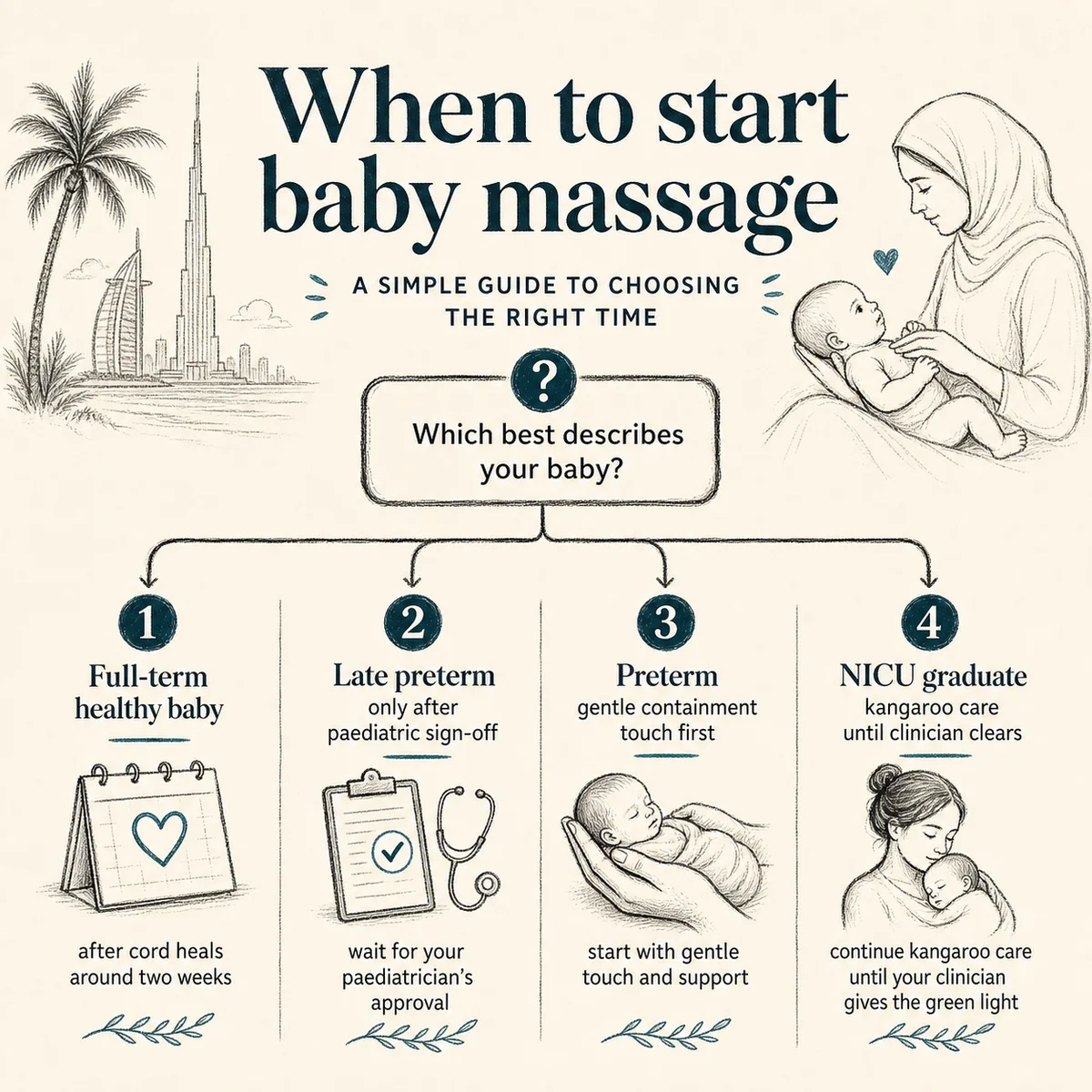
When can you start?
For a healthy full-term baby, the usual window is after the umbilical cord stump has separated and the navel has healed, which most families reach by week two. The reason is skin: the newborn barrier is still maturing and the vernix microbiome is settling, so oils and pressure are kinder a little later (WHO newborn care).
Preterm and NICU babies are different. Full-body oil massage waits until the paediatrician clears it. Before that, kangaroo care and gentle containment touch, a still hand resting on the back or head, are the safer starting point. The strongest evidence for infant massage actually sits here: a Cochrane review found regular massage in stable preterm infants was associated with better weight gain and shorter hospital stay (Cochrane Library).
Most healthy babies enjoy massage from two weeks through the first year. The DHA expects a newborn check at 48 hours, two weeks and six weeks, useful moments to ask your clinician whether your baby is ready.
How to massage your baby, step by step
Set the room first. Warm, draught-free, soft light. Plan it at least 45 minutes after a feed, when the baby is awake but calm. Lay a folded muslin or towel, undress to the nappy, and warm a small amount of oil between your palms.
Then move through the body in this order, around ten minutes total:
- Legs and feet. Long downward strokes from thigh to ankle, then small circles on the soles.
- Arms and hands. Same long stroke, shoulder to wrist, open the palm gently.
- Chest. Both palms flat, stroke outward from the centre, like opening a book.
- Tummy. Soft clockwise circles around the navel, following the colon's path.
- Back. Baby on tummy or across your lap, long strokes from shoulders to bottom.
- Face. Light fingertip strokes from the centre outward, skipping the eyes.
Pressure should be feather-light in the first month and gradually firmer. Watch the baby. Cooing, eye contact, soft hands: continue. Arching, turning the head away, fussing: stop. The cue is the clock here.

A small scene from the BestDOC newborn rota last month: Reem, a first-time mother in Al Barsha, had a three-week-old who fussed every evening from seven to ten. Our newborn nurse, Maria, visited for one demo. They worked through the I-L-U belly stroke (an "I" down the left side, an inverted "L", then an inverted "U" tracing the colon), twice a day for seven days. By day five the evening crying window had halved. By day ten it was gone. Reem had not started a new product, a new formula or a new schedule. She had learned ten minutes of touch.
Want a one-time, in-home demo? Our DHA-licensed newborn care nurses can come, watch you do it, and adjust the technique on your own baby.
Oils, colic and when to stop
In a Dubai household, cold-pressed, food-grade plant oils generally edge ahead. The indoor air is dry and air-conditioned, so a barrier-supporting oil sits well on the skin. Coconut, sweet almond and sunflower are all reasonable. Sesame and mustard are culturally common but higher-allergen, so patch-test a small drop on the inner forearm for 24 hours before the first full massage. Skip oil entirely on broken skin or a fresh eczema flare.
For colic and constipation, the I-L-U abdominal stroke is the most-cited home technique. NICE's UK guidance acknowledges modest evidence for parent-led massage in colic symptom relief (NICE). Do it gently, twice a day, for a week, then reassess.
Stop and call a paediatrician if any of the following appear: fever above 38°C, fresh vaccination on that limb in the last 24 hours, blood in the stool, refusing feeds, poor weight gain, or persistent inconsolable crying beyond three weeks (HealthyChildren.org, AAP). Colic-shaped symptoms can mask cow's-milk protein allergy or reflux, and a home doctor visit is the right next step before any product change.
Closing
Baby massage is one of the quietest, oldest forms of care, and a small, daily ten minutes is usually enough. Start when your baby is ready, watch the cues, keep the oil simple, and stop when something does not feel right.
If you would like a nurse to demo the technique on your own baby, book a newborn care visit or call our 24/7 line on +971 800 2378 362. A DHA-licensed maternity care nurse can come the same day, anywhere in Dubai, and stay for a full feed-and-sleep cycle so you can practise with supervision. You can read more about BestDOC's clinical team and how we match the same nurse to your case from the first visit.
Educational. Not medical advice. Consult a licensed clinician.